


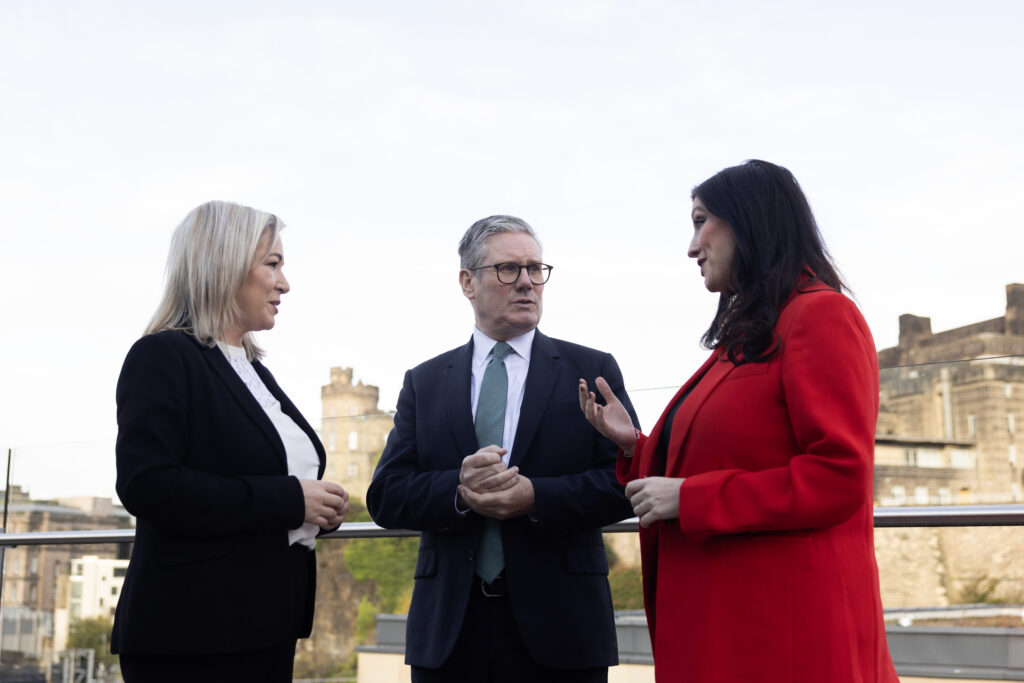
What are intergovernmental relations?
In the UK, intergovernmental relations describe the engagement between the UK Government and devolved governments in Northern Ireland, Scotland and Wales. They include formal and informal contact between ministers and civil servants using multilateral or bilateral channels.
The introduction of devolution in 1998 changed the territorial constitution of the UK. Intergovernmental relations between the UK Government and new devolved governments in Belfast, Edinburgh and Cardiff became central to ‘manage the intersection between devolved and reserved powers, and to support joint decision-making where governments share responsibilities.’[1]
Between 1999 and 2022, intergovernmental relations were set out in the Memorandum of Understanding on Devolution (MOU). First published in October 1999 and updated through October 2013, the MOU created a Joint Ministerial Committee that brought together ministers from the UK and devolved governments on a consultative and ad-hoc basis.
The Brexit process and COVID-19 significantly raised the profile of intergovernmental relations in the UK. Membership of the EU’s single market had limited the scope of policy divergence because many EU-level decisions applied across the UK. When these policy areas were returned, intergovernmental relations became key to managing the UK’s internal market. Similarly, the COVID-19 pandemic placed intergovernmental structures under strain. The Joint Ministerial Committee was largely sidestepped and devolved representatives were instead invited to attend Cabinet Office Briefing Room (COBRA) meetings.
During this period, several parliamentary and government reviews reached similar conclusions on intergovernmental relations reform. For example, a 2018 report of the Commons Public Administration and Constitutional Affairs Committee noted a ‘growing consensus’ that current mechanisms are ‘not fit for purpose’ and said its evidence ‘overwhelmingly called for extensive reform or replacement’.
The devolved governments also viewed reform as necessary and, through the Joint Ministerial Committee in 2018, initiated a formal review of the existing structure. Following the publication of the Review of Intergovernmental Relations in 2022, a new architecture for intergovernmental relations was introduced.
How are intergovernmental relations structured in the UK?
The Review of Intergovernmental Relations introduced a new system of engagement in January 2022, agreed by all four central and devolved governments. The Joint Ministerial Committee system was replaced by a three-tier structure consisting of: the Prime Minister and Heads of Devolved Government Council; interministerial standing committees; and policy-specific interministerial groups. These groups are scheduled to meet regularly rather than taking place on an ad-hoc basis, as in the previous arrangements.
The review states that intergovernmental working will be founded on five principles:
- Maintaining positive and constructive relations, based on mutual respect for the responsibilities of the governments and their shared role in the governance of the UK
- Building and maintaining trust, based on effective communication
- Sharing information and respecting confidentiality
- Promoting understanding of, and accountability for, their intergovernmental activity
- Resolving disputes according to a clear and agreed process.

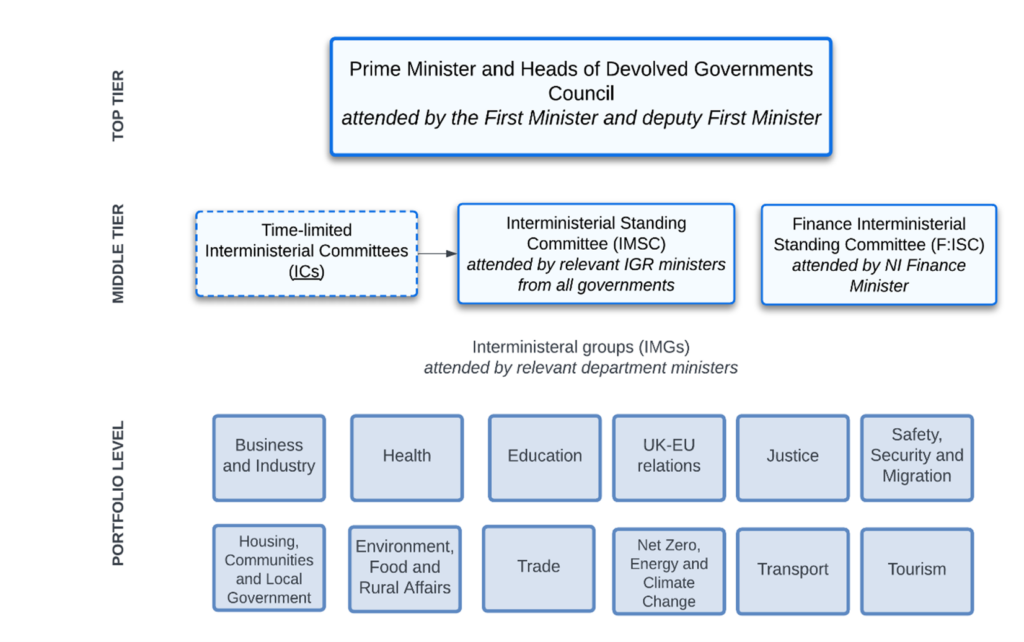
At the top tier, the Prime Minister and Heads of Devolved Governments Council is responsible for overseeing intergovernmental relations in the UK. It is intended to meet annually and is chaired by the Prime Minister. The Council’s functions include setting strategic policy direction and acting as the final stage in the dispute resolution processes.
At the middle tier, interministerial standing committees consider issues affecting several portfolios and any cross-cutting international issues. These include the Interministerial Standing Committee (IMSC) and Finance: Interministerial Standing Committee (F:ISC), both of which aim to facilitate policy collaboration across governments. They are made up of relevant ministers from all governments and are chaired by members on a rotating basis.
At the portfolio tier, interministerial groups enable regular department-level engagement on specific policy areas. They are organised and supported by participating teams for each government and effectively replace the previous Joint Ministerial Committees.
These bodies are supported by a standing Intergovernmental Relations Secretariat, which is accountable to the council and must serve all governments equally and impartially. Hosted and funded by the Cabinet Office with staffing across all governments, the secretariat is tasked with administrative support, maintaining relations across tiers and facilitating dispute resolution.
What about the Belfast/Good Friday Agreement?
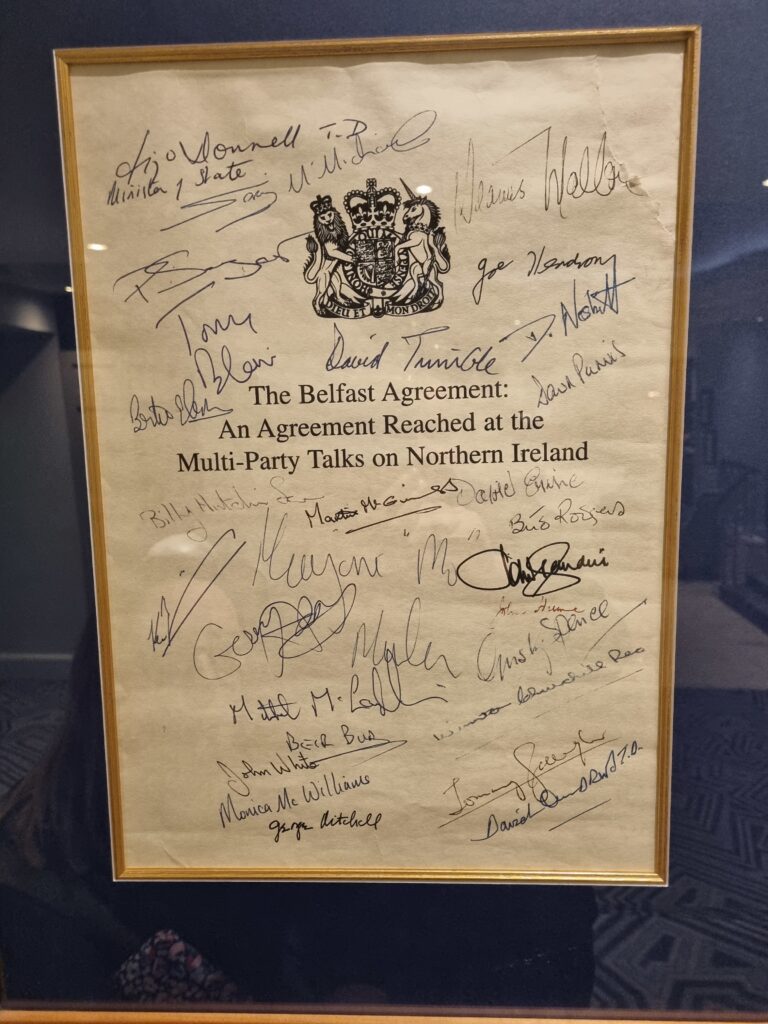
Intergovernmental relations in Northern Ireland are particularly significant and take a distinctive shape. British and Irish relations, alongside American facilitation, played an important role in reaching the Belfast/Good Friday Agreement in 1998. Strands Two and Three of the Agreement considered intergovernmental relations through a constitutional and partially international framework. In doing so, they created several intergovernmental bodies involving the governments of Northern Ireland, the UK, and the Republic of Ireland that operate alongside the structure outlined above. More recently, the East-West Council was also created in 2024 as part of the Executive’s restoration.

The North/South Ministerial Council (NSMC) brings together government ministers from Northern Ireland and Republic of Ireland to ‘develop consultation, co-operation and action within the island of Ireland’. It works to agree common policy approaches that are implemented by each government and manages several cross-border and all-island bodies such as Waterways Ireland and InterTradeIreland. A joint secretariat, based in Armagh and staffed by personnel from the Irish Civil Service and the Executive Office, supports the NSMC.
The British-Irish Council (BIC) brings together the governments of UK, Ireland, Guernsey, Jersey, the Isle of Man, Scotland, Wales and Northern Ireland. It aims to ‘promote the harmonious and mutually beneficial development of the totality of relationships among the peoples of these islands’ and provides a forum for cooperation on several issues such as climate decarbonisation, culture and heritage, and economic and social inclusion.[3] Since 2012, it has been supported by an Edinburgh-based standing secretariat, headed by officials from the UK and Irish Governments, and staffed with officers from the Northern Ireland, Scottish and Welsh Governments.
The British-Irish Intergovernmental Conference (BIIGC) brings together the Irish and UK Governments for bi-lateral cooperation on non-devolved matters. It aims ‘to promote bilateral cooperation at all levels on all matters of mutual interest within the competence of the UK and Irish Governments’, and replaced the Anglo-Irish Intergovernmental Conference, created under the 1985 Anglo-Irish Agreement. It is supported by a standing joint secretariat based in Belfast.
The East-West Council was created as part of the return of the Northern Ireland Executive in 2024 and met for the first time in March of that year. Its format was outlined in the Safeguarding the Union Command Paper – the deal which effectively restored power sharing institutions in Northern Ireland after they had ceased to fully function 24 months earlier. The East-West Council brings together government, civil society and business representatives from across the UK. It aims to raise the profile of Northern Ireland in business and government, as well as fostering links across education, sport and culture.
How have intergovernmental relations operated under the Labour Government?
In the leadup to the 2024 UK General Election, the Labour Party announced that it would ‘reset’ intergovernmental relations. To achieve this, the party’s Change manifesto committed to creating a new Council of the Nations and Regions and introducing a Memorandum of Understanding on legislative consent.
The creation of a new Council of the Nations and Regions was one of the first acts of the Starmer Government after its election victory in July 2024. The Council brings together the Prime Minister, heads of devolved governments, and English metro mayors. It aims to facilitate working between central, devolved and local governments and takes a structured approach to cross-cutting issues. It held its inaugural meeting in Edinburgh in October 2024 and met for a second time in London in May 2025. Like many intergovernmental relations bodies, it is supported by a standing secretariat of UK Government officials.
In addition to creating the Council of Nations and Regions, the Labour manifesto also pledged to strengthen legislative consent. To do so, it said the Government would introduce a new Memorandum of Understanding on the Sewel convention, ‘outlining how the nations will work together for the common good’.[4]
Under the Sewel Convention, the UK Parliament retains sovereignty to legislate on devolved areas, but they will ‘not normally’ do so ‘except with the agreement of the devolved legislature.’ In practice, this means that the UK Government is expected to consult with devolved governments when it plans to legislate on a relevant issue. Devolved legislatures then vote on a legislative consent motion that may grant or withhold consent for the bill.
As a constitutional convention, however, it is not legally binding, and the UK Parliament may pass bills without devolved consent. Ministers from both Scotland and Wales have criticised the previous UK Government’s willingness to legislate without devolved consent, a practice that became more frequent after Brexit.[5] Since Labour entered government in 2024, there has been some progress towards a Sewel Convention Memorandum of Understanding. Writing to the Scottish Affairs Committee Chair in February 2025, the Secretary of State for Scotland Ian Murray said,
The Chancellor of the Duchy of Lancaster is leading on the coordination of this work, closely supported by the Secretaries of State for Northern Ireland, Scotland, and Wales. Initial conversations between officials in each government took place last year and we look forward to continuing that soon.[6]
_________________________________________
[1] Devolution and intergovernmental relations, POST, 2024
[2] Brexit and Devolution, Northern Ireland Assembly, European Affairs team (undated)
[3] British-Irish Intergovernmental Conference (BIIGC) April Joint Communiqué
[4] Serving the country – The Labour Party
[5] See discussion in Inter-institutional relations agreement between the Senedd and the Welsh Government, Welsh Government, 2025; and The intergovernmental relations ‘reset’: one year on, SPICe Briefing, 2025
[6] Correspondence from The Rt Hon Ian Murray MP to Patricia Ferguson MP, 26 February 2025