



Northern Ireland: Fleadh Cheoil na hÉireann
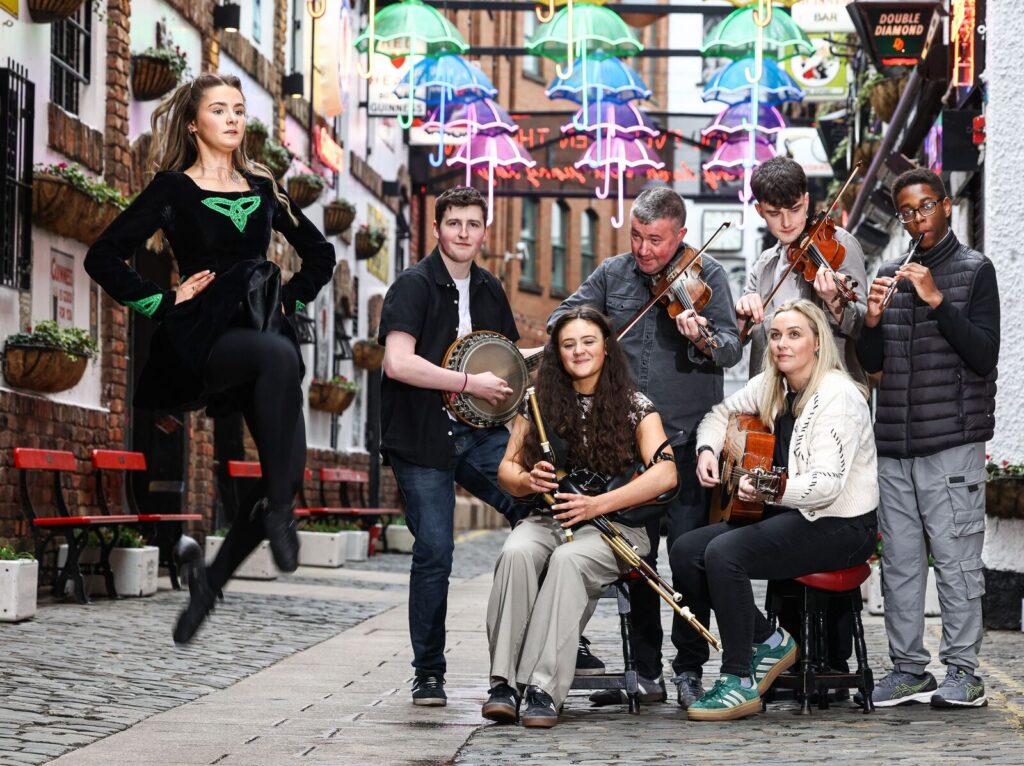
The Fleadh Cheoil na hÉireann is the largest global festival of Irish traditional music, language, and culture, organised by the non-profit cultural organisation, Comhaltas Ceoltóirí Éireann (CCÉ). Founded in Mullingar in 1951, Comhaltas established the Fleadh to preserve and promote Irish traditional music, song, dance and culture at a time of significant economic and social change in Ireland and against a backdrop of emigration, rural decline and a waning interest in the traditional arts. Today, the festival presents traditional Irish music competitions, concerts, céilís, workshops and street sessions, as well as a range of language, art and heritage fringe events to a wide range of local and international audiences. The Metropolitan Arts Centre (MAC) will be the Irish language hub, hosting a range of language-based events, and the Sgoil Éigse offers a free summer school for musicians of all ages. The Fleadh is in Belfast for 2026, celebrating its 75th anniversary, and again in 2027.
Economic impacts
The 2026 Belfast Fleadh is only the second time the festival has come to Northern Ireland, taking place in Derry/Londonderry in 2013, when the city had been awarded the title of UK City of Culture. A 2014 monitoring report on the Derry/Londonderry Fleadh stated that it attracted over 430,000 visitors with an estimated £21.5 million benefit to NI businesses. In 2024 and 2025, the Wexford Fleadh welcomed over 650,000 and then 800,000 visitors and generated around €60 million for the town successively. This year, the event is anticipated to see similarly high visitor numbers of between 700-800,000 and an economic benefit of around £60 million. Over 1,300 volunteers have also signed up in a variety of roles to help deliver the event.
The Fleadh is aligned with governmental priorities in regional tourism, cultural development, and regeneration, and is supported primarily by Belfast City Council and Comhaltas Ceoltóirí Éireann (CCÉ). Other support organisations include Tourism Northern Ireland, who have provided an additional £1 million in support, the local Ards CCÉ branch and Arts Council NI. The Féile an Phobial, another large-scale community arts festival based in West Belfast, has also received a 13% funding increase this year, supporting its continued growth as it expects to deliver around 600 events across the city.
Economic benefits can be the most visible legacy of major cultural events, with visitor spending, tourism activity and business revenue providing a clear and measurable return on public investment. The Department for the Economy has announced two pieces of independent research which will assess the social and economic impact of the Irish language and support for the Irish medium workforce. The first report is due in autumn 2026 and will examine the benefits of investing in language learning and engagement. Large scale cultural events such as the Fleadh and the Féile can provide a unique evidence base for language research and inform the development of wider cultural, heritage and legacy frameworks.

Cultural context
The Northern Ireland Statistics & Research Agency (NISRA) found that 16% of adults had some knowledge of Irish and that 19% had some knowledge of Ulster Scots in 2024/2025. The Continuous Household Survey of 2023/24 reported that 20% of adults had attended an Irish cultural event in the previous year, including by attending the Fleadh (3%) or a féile (4%). Attendance at an Ulster Scots cultural event was 13%, with events including festivals (2%). The 2025 Northern Ireland Life and Times (NILT) survey found that both the Irish (56%) and the Ulster Scots (45%) languages are considered to add to the region’s richness and diversity. Respondents also reported wanting to see or hear a lot (22%) or a little (18%) more of the Irish language in everyday life, as well as a lot (6%) or a little (15%) more Ulster Scots. Under the Identity and Language (Northern Ireland) Act 2022, the Northern Ireland Executive established the Office for Identity and Cultural Expression (OICE), and installed commissioners for both the Irish language and the Ulster Scots and the Ulster British Tradition.
With this, the Fleadh may offer a well-timed platform to raise awareness and understanding of the wider linguistic and cultural landscape of Northern Ireland. Examining comparable large-scale cultural and minority language events in other jurisdictions can be useful to better understand their potential economic benefits, as well as their impact on language visibility and broader public engagement with regional languages and cultural heritage.
Scotland: The Royal National Mòd
Am Mòd Nàiseanta Rìoghail (The Royal National Mòd) is Scotland’s largest annual festival celebrating the Scottish Gaelic language, arts and culture. The Mòd was founded by An Comunn Gàidhealach in Oban in 1892 and similarly moves between different host cities across Scotland each year. Its programme combines formal competitions with a wide array of concerts, cèilidhs, workshops, talks, community gatherings and performances. The NYC National Tartan Week Mòd now also runs annually, promoting Gaelic language and culture on a global stage and celebrating the rich cultural history of the Gaelic diaspora.
The Scottish Languages Act (2025) recognised Gaelic and Scots as official national languages of Scotland, underpinning the ambitions of the Scottish Government’s Gaelic Language Plan 2022-2027. Central to this is the statutory body for Gaelic, Bòrd na Gàidhlig, responsible for promoting the Gaelic language, advising on Gaelic policy, implementing Gaelic language plans and funding Gaelic cultural projects, including the Mòd.
The Royal National Mòd 2024 Evaluation Report recorded 9,000 visitors to Oban and a generated £3.6 million for the local economy, with £1.9m in Gross Value Added (GVA). It also reported that the event supported the equivalent of 63 full-time jobs. In a survey of 464 attendees, 98% used local restaurants, cafés or pubs, 90% visited local shops, and 78% travelled to local attractions or places of interest. Visitors believed more strongly in the importance of Gaelic (78%) after the events and were encouraged to improve their Gaelic language skills (67%) as a result. In 2025, the Lochaber Mòd generated a £3.9 million benefit to the local economy, welcoming over 9,400 visitors and supported an estimated 69 full time-equivalent jobs. Again, 95% of surveyed attendees visited local restaurants, cafés or pubs and 83% said they believed more strongly in the importance of Gaelic after visiting the Mòd.
The 2026 Mòd will take place later this year in Glasgow. Last held in the city in 2019, the Evaluation of the Royal National Mòd report found the event had generated an estimated £3.2 million with around 12,000 attendees. Glasgow is well known as a centre for Gaelic language and culture, with The Gaelic Economy in Glasgow (2022) report estimating that festivals and events attributed to Gaelic generate £7.2 million annually for the city, while Gaelic-related activity supports more than 700 full time equivalent jobs and around £21.6 million GVA per annum. The research highlights the creative industries, education and learning, tourism, hospitality and events, and language development as key sectors in Glasgow’s Gaelic economy. In terms of language revitalisation, there is a clear link between the economic viability of a regional or minority language and the increased provision of those ‘intangible assets’ such as cultural enrichment, knowledge and skills.[1]
It will be interesting to compare the successes this year of the Mòd in Glasgow and the Fleadh in Belfast, as both look to engage local as well as global audiences in large urban settings to deliver on similar strategic economic and social priorities.
Wales: The National Eisteddfod
In Wales, the National Eisteddfod is the country’s largest celebration of the Welsh language and one of the most important expressions of Welsh cultural identity. This year the festival takes place in Llantwd in North Pembrokeshire from 1 to 8 August and celebrates its 850th anniversary, dating back to 1176. The Welsh Government are supporting a series of summer events to celebrate the milestone and to encourage more people to engage with Welsh language events.
In 2024, the Rhondda Cynon Taf Eisteddfod saw 115,554 more visitors to the town centre of Pontypridd than the previous year, 503 people volunteered at the events, and visitors were given discounted tickets to other local attractions. The 2025 Wrexham Eisteddfod saw 175,000 people visit the festival and projections were for an economic benefit of up to £16 million for the local economy. The Urdd National Eisteddfod is an associated Welsh youth festival organised by the National Voluntary Youth Organisation, Urdd Gobaith Cymru. The Assessment of the economic value of the Urdd Gobaith Cymru 2023 found it had generated £16 million, with an £8.5 million direct impact to the local host area of Carmarthenshire. The report also stated that from 2022-2023, the Urdd Gobaith Cymru generated £44.9 million in its wider activities.
The Welsh Senedd’s Culture, Communications, Welsh Language, Sport and International Relations Committee held an inquiry in 2024, Cymraeg for all?, which examined the policies and interventions that could be developed to increase engagement across Wales with the Welsh language.[2] The 2026 Committee report highlighted the importance of Welsh language festivals and events and the positive impact that the planning and organisation within local communities can have in creating a sense of ownership and inclusion ahead of the events. The report also noted a lack of resources for the post-festival and legacy work of the Eisteddfod, with provision often coming from existing event budgets. Its recommendations included the development of the National Eisteddfod Legacy Framework, delivered in March 2026, as well as a dedicated fund for legacy work, to ensure that the successes and momentum generated by the events can have lasting and measurable impacts.
The Legacy Framework focusses on several key practical areas including education, community confidence, inclusivity, digital participation, cultural careers, tourism, volunteering and everyday Welsh-language use. It also emphasises the need for local as well as national research to support the delivery and continued growth of the Eisteddfod. This includes Welsh language mapping and partnership building exercises in the host areas, as well as commissioned research every three years to assess economic, social and cultural progress. These will be measured against the Welsh language strategy, Cymraeg 2050, and relevant priorities in the Well-being of Future Generations (Wales) Act 2015.
As Belfast prepares for the Fleadh Cheoil na hÉireann, it is useful to consider how strategic economic, cultural and language planning objectives can be embedded into festival design, delivery and evaluation. Examples from other regions highlight that legacy planning can also be an important area of focus if economic, social and cultural benefits are to be maximised. Looking beyond the UK, festivals such as Norway’s Riddu Riđđu Festivàla, which celebrates the indigenous Sámi language and culture, could offer further insight for future research into how large-scale cultural events can support regional language and cultural planning.
_______________
[1] M Danson, ‘Gàidhlig, Gaeilge, Cymraeg and Føroyskt Mál: Minority Languages as Economic Assets?’, Language Revitalisation and Social Transformation (2021)
[2] O Bowyer, Cymraeg for all? Creating meaningful opportunities to use Welsh, Senedd Research (19 March 2026)