



This blog article contains references to domestic abuse and domestic homicide which some readers may find distressing. Please read with care. If you are affected, support is available through organisations such as Women’s Aid.
Recent cases of women being violently killed in Northern Ireland have prompted significant public debate towards the implementation of Jade’s Law and how the justice system protects children and bereaved families after domestic homicide.
Jade’s Law allows the parental responsibility of a parent who kills the other parent to be automatically suspended following conviction. This means they can no longer make decisions about the child’s life unless a court decides otherwise.
While the law has been passed in England and Wales, it does not apply in Northern Ireland, raising important questions about parity, child safeguarding, and the role of parental responsibility in cases involving the most serious form of domestic abuse.
Domestic abuse: Definitions and context
Women’s Aid defines domestic abuse as ‘an incident or pattern of incidents of controlling, coercive, threatening, degrading and violent behaviour, including sexual violence, in the majority of cases by a partner or ex-partner, but also by a family member or carer.’
Domestic homicides – where a person is killed by an intimate partner, family member, or carer – frequently occur against a backdrop of prior abuse. Research indicates that risk of escalation increases at the point of separation, during pregnancy, and when children are present in the household.
Domestic abuse in Northern Ireland
According to Police Service of Northern Ireland (PSNI) data from 2024/25 (compared to the same period in the previous financial year):
- Domestic abuse incidents decreased by 9.2% (29,751 incidents)
- Domestic abuse crimes decreased by 7.8% (18,393 crimes)
- 67.3% of victims were female and 32.5% were male.

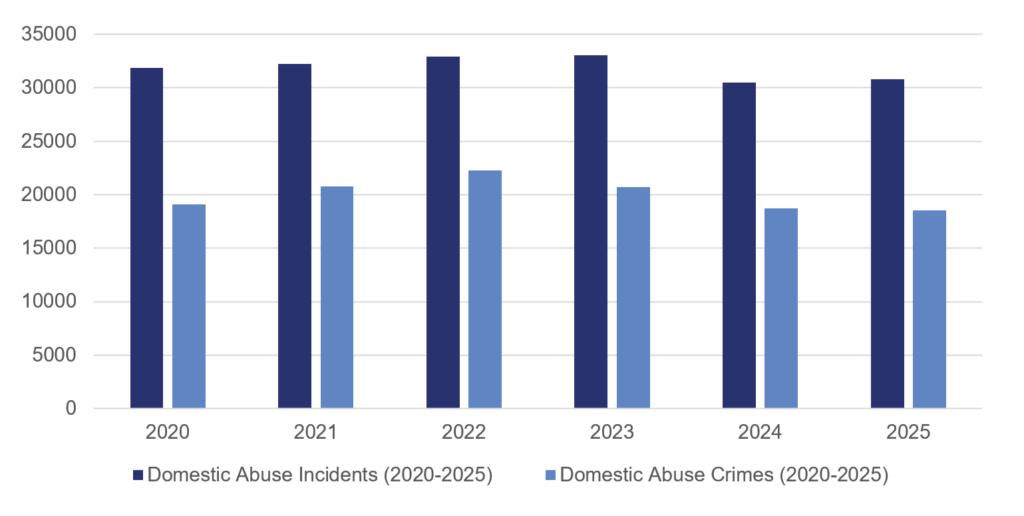
Domestic abuse incidents are recorded when circumstances meet the definition of domestic abuse. A crime is recorded only when the incident meets the threshold for a criminal offence. As such, crimes are included in the incident count and the two should not be added together.
As with other United Kingdom jurisdictions, research suggests that thresholds and individual interpretations of ‘severity’ may vary, meaning recorded crime figures may not fully reflect the prevalence of the issue.
Domestic abuse involving children in Northern Ireland
Women’s Aid suggests that when a woman becomes pregnant, her risk of domestic abuse victimisation increases by 30%. Additionally, in 90% of domestic incidents, children are in the same or an adjacent room.
The Domestic Abuse and Civil Proceedings Act (Northern Ireland) 2021 introduced a Child Aggravator Clause, which increases the seriousness of an offence where a child under 18 is present or witnesses the abuse. An aggravator clause can also be triggered by an offence when:
- a child is used to abuse another person;
- when abusive behaviour is (or is threatened to be) directed at the child;
- when a reasonable person would consider that the behaviour would be likely to adversely affect the child.
PSNI statistics for April 2025–March 2026 indicate that the Child Aggravator Clause was applied in a number of cases:
- 26 cases involved a direct victim under 18,
- 250 cases involved a child who was present, witnessed the abuse, or was otherwise affected, triggering the Child Aggravator Clause.
Domestic homicides involving children in Northern Ireland
Media and publicly reported data indicate that, since 2020, 30 women have been killed in domestic homicides in Northern Ireland. Of these:
- 15 (50%) were killed by a partner or ex‑partner.
- 14 of these 15 victims had children.
- At least seven of these 14 had children fathered by the perpetrator.
- Parentage was unconfirmed in four cases.
These figures are based on media reporting and publicly available case information. Sub-categories (for example, whether the perpetrator was the father of the victim’s children) are derived from available case details and may not be complete in all cases.
These figures highlight the scale of domestic abuse in Northern Ireland and underscore the importance of considering how parental responsibility operates in cases involving serious harm or homicide. In at least seven of the domestic homicide cases since 2020, the perpetrator was the father of the victim’s children. Under current Northern Ireland law, those fathers would continue to hold parental responsibility unless a court intervened. This means that, even after the homicide, their children may still have ongoing legal ties to them, including the potential for decisions about schooling, medical treatment, travel, or access to support services to require their involvement.
For bereaved families, this can result in prolonged contact with the perpetrator through family court processes, administrative requests, or routine parental‑responsibility decisions. In practice, this can place children and extended family members in a position where the person responsible for the homicide retains a degree of influence over the child’s life, creating additional trauma and uncertainty at an already devastating time.
Parental responsibility: Legal framework
In Northern Ireland, ‘parental responsibility’ refers to the full range of legal rights and duties a parent has in relation to their child. Under the Children (Northern Ireland) Order 1995, it encompasses decision‑making in areas such as education, health, religion and legal matters, as well as the ability to appoint a guardian for the child.
Who has automatic parental responsibility?
- Mothers
- Fathers – if they are married to the mother at the time of the child’s birth.
- For children born on or after 15 April 2002, a father who is named on the birth certificate also automatically acquires parental responsibility.
Rights and duties
Individuals with parental responsibility can:
- Make decisions about the child’s education, including school choice and access to reports.
- Consent to medical treatment and determine the child’s religion.
- Decide on the child’s name or any change of name.
- Protect and provide for the child, including safeguarding welfare.
- Appoint a guardian in the event of death.
Others who may hold parental responsibility include grandparents, stepparents, and special guardians may acquire parental responsibility through court orders.
Jade’s Law (England and Wales)
Jade’s Law was introduced through the Victims and Prisoners Act 2024 (Section 18) in England and Wales following the murder of Jade Ward in 2021. Jade’s Law provides that when a parent is convicted of killing the other parent, their parental responsibility is automatically suspended. The policy intention is to prevent convicted perpetrators from influencing decisions relating to a child’s schooling, medical care, travel, or access to therapeutic services.
Although Jade’s Law received Royal Assent in 2024, it has not yet been commenced. The United Kingdom Government has stated that commencement requires additional statutory instruments, and until these are in place, courts in England and Wales cannot apply the automatic suspension provisions.
Delivering the legislation also involves a substantial and carefully co‑ordinated programme of operational work. This is expected to include secondary legislation, likely amendments to the Criminal Procedure Rules and Family Procedure Rules, updates to judicial guidance, and significant procedural and training changes across the police, legal profession, local authorities, the CPS, HMCTS, Cafcass, Cafcass Cymru and the Prison Service. The Ministry of Justice has said that the planned commencement date is now the end of December 2026.
Considerations for Northern Ireland
Family Law is a devolved matter in Northern Ireland, meaning that the legislation which contains Jade’s Law does not apply here. Without an equivalent to Jade’s Law, a parent convicted of killing the other parent continues to hold parental responsibility in Northern Ireland unless a court intervenes. This places the burden on bereaved families, often already traumatised, to initiate legal proceedings to restrict or remove those rights.
As a result:
- A parent convicted of killing the other parent retains parental responsibility unless a court order removes or restricts it.
- Families may need to engage with the family court system to alter parental responsibility arrangements.
Campaign activity has emerged in Northern Ireland, including a petition launched in April 2026 seeking the inclusion of a Jade’s Law‑style provision within the Criminal Justice (Sentencing etc.) Bill. The petition highlights:
- The desire for parity with England and Wales;
- The potential benefits for children and bereaved families;
- Concerns about the burden placed on families under current arrangements.
As debate and campaigning intensify, policymakers in Northern Ireland face a key choice: introduce automatic suspension of parental responsibility in the most serious cases, or retain the current court-led approach. Any reform must balance child welfare, victims’ rights, and due process, while ensuring the necessary legislation is in place to avoid delays seen in England and Wales, where implementation has been held up pending supporting regulations.
On 1 June 2026, the Finance Minister acknowledged concerns about implementing Jade’s Law in Northern Ireland, stressing that policy must be developed alongside the practical steps needed for effective delivery. He confirmed engagement with the Justice Minister due to impacts on both family and criminal justice systems, and has asked officials to explore wider reforms to parental responsibility and private family law.
While noting strong support from stakeholders, including Women’s Aid and campaigners, he emphasised the need for a thorough, consultative process (expected later in 2026) to inform legislation in early 2027. He also highlighted the importance of learning from challenges in England and Wales to ensure the law is workable and effective. Diane Forsythe MLA raised concerns that, given high femicide rates and court delays, mirroring the current model could leave children without protections for years while awaiting convictions. She questioned what immediate support family courts can provide. In the months ahead, further debate is likely on whether Northern Ireland should adopt a similar model or develop a more tailored approach.