



Carers Rights Day, observed on 20 November, is intended to raise awareness about the rights of the UK’s 5.8 million unpaid carers and the support available to them. CarersUK organises the day, with this year’s theme being ‘Know your rights, use your rights’. The stated goal of the day is to help carers understand their rights and be supported to use them if they wish. As stated on the CarersUK website:
Every day 12,000 people become unpaid carers for a partner, family member or a friend – many of whom don’t see themselves as carers, often unaware of their legal rights and what they are entitled to in terms of support and benefits.
Despite the importance of care in all societies, carers (especially unpaid carers) face considerable challenges including an increased likelihood of poverty, employment penalties and reduced wellbeing.
This blog article will specifically focus on unpaid carers and the challenges they face. It will provide a brief overview into unpaid care in the global context, the extent of unpaid care in Northern Ireland, the challenges unpaid carers face and finally what measures can be introduced to support them. Please note that when the blog article refers to ‘carers’, it refers to unpaid carers.
This article builds upon a 2024 RaISe paper, titled ‘Support for Unpaid Carers in Northern Ireland: a preliminary consideration’. The paper provides information about unpaid carers in Northern Ireland as well as options for how they can be supported.
Unpaid care in the global context
In their 2018 report ‘Care Work and Care Jobs: For The Future of Decent Work’, the International Labour Organisation (ILO) and the UN defined unpaid carers as ‘persons who provide unpaid care or support to members of their own household, of other households in the community, who have care or support needs.’ This definition includes childcare.
The report found that most global care work is undertaken by unpaid carers. Women and girls provide 76% of unpaid care worldwide. In no country is there an equal gender balance between men and women providing unpaid care. Gendered inequalities in unpaid care (and in wider employment in general) tend to originate in the gendered idea of the role men and women play in society. The UN report indicates that gendered norms continue to influence care roles in many countries, where men typically fall into ‘productive roles’ (ie the male breadwinner) and women act as the primary care giver.
Gendered attitudes to employment and care are slowly changing worldwide. As of 2018, men have never been more involved in care and family life. However, estimates from the UN in 2018 found that it may take another 210 years to close the gender gap in unpaid care. And this is only for those countries that produce statistical data on unpaid carers.
This imbalance in unpaid care can result in certain gendered impacts. These include:
- The motherhood employment penalty. According to the ILO/UN report, women’s time on unpaid care increases in most cases when young children are present. Mothers of children aged between 0-5 have the lowest rate of employment (48%), compared to fathers of children of the same age (88%).
- The job quality penalty. Unpaid care is one of the main obstacles to women moving into higher quality jobs. Women in employment are likely to work shorter hours if they have family responsibilities. The expectation of long working hours in typically male dominated sectors (such as IT), can act as a deterrent to women. This contributes to occupational segregation.
The report concluded that:
No substantive progress can be made in achieving gender equality in the labour force before inequalities in unpaid care are first tackled through the effective recognition, reduction and redistribution of unpaid care between women and men, as well as between families and the state.
Unpaid care in Northern Ireland
The Northern Ireland 2021 Census defined an unpaid carer as follows:
…a person is a provider of unpaid care if they give any help or support to anyone because of long-term physical or mental health conditions or illnesses, or problems related to old age. This does not include any activities as part of paid employment.
This definition is slightly narrower than the definition used by the UN and ILO, as it does not include childcare responsibilities as a part of unpaid care. Research from CarersNI found that in Northern Ireland, unpaid care saves the Northern Ireland Executive approximately £5.8 billion in costs each year.
There are around 222,000 people providing some form of unpaid care in Northern Ireland, as reported in the 2021 Census. This represents around 12% of the total population and is an increase from the 56,000 unpaid carers reported in the 2011 Census data. 180,000 carers are of working age, while 2,500 are under the age of 15.
As with other countries worldwide, there is a gendered dimension to unpaid care in Northern Ireland, where 59% of all unpaid carers are women.
Spotlight on the Gender Equality Index UK
The recently released Gender Equality Index UK (GEIUK), developed by academics from King’s College London, is intended to measure and map women’s and men’s socioeconomic outcomes across local authorities in England, Wales, Scotland and Northern Ireland.
The GEIUK examines six domains, including Paid Work, Unpaid Work, Money, Participation, Education and Health, drawing on a variety of data sources from 2021-23. The indicators used for unpaid care are:
- Daily childcare: Average daily time in minutes spent providing childcare (ages 18+)
- Weekly domestic work: Average weekly time in hours spent on housework, such as cooking, cleaning and laundry (ages 16+)
Other indicators of unpaid care could not be added due to the difficulty in comparing the data with other regions of the UK.[1] Despite this, the GEIUK still shows that local authorities in Northern Ireland have among the lowest level of equality when looking at unpaid care. When ranked from 1 (lowest) to 10 (highest), all local authorities in Northern Ireland, bar two, scored 1. Belfast has a score of 2, with Ards and North Down scoring 3.
The risks of poverty faced by unpaid carers
One of the most notable aspects of unpaid care in Northern Ireland is the extent of poverty amongst unpaid carers. Data from 2023 found that almost 31% of carers in Northern Ireland provide more than 50 hours of unpaid care a week and research from the Carer Poverty Commission found that those providing long hours of unpaid care (over 35 hours per week) are at the highest risk of poverty.
The map below provides a view of the number of unpaid carers providing more than 50 hours of unpaid care per week.
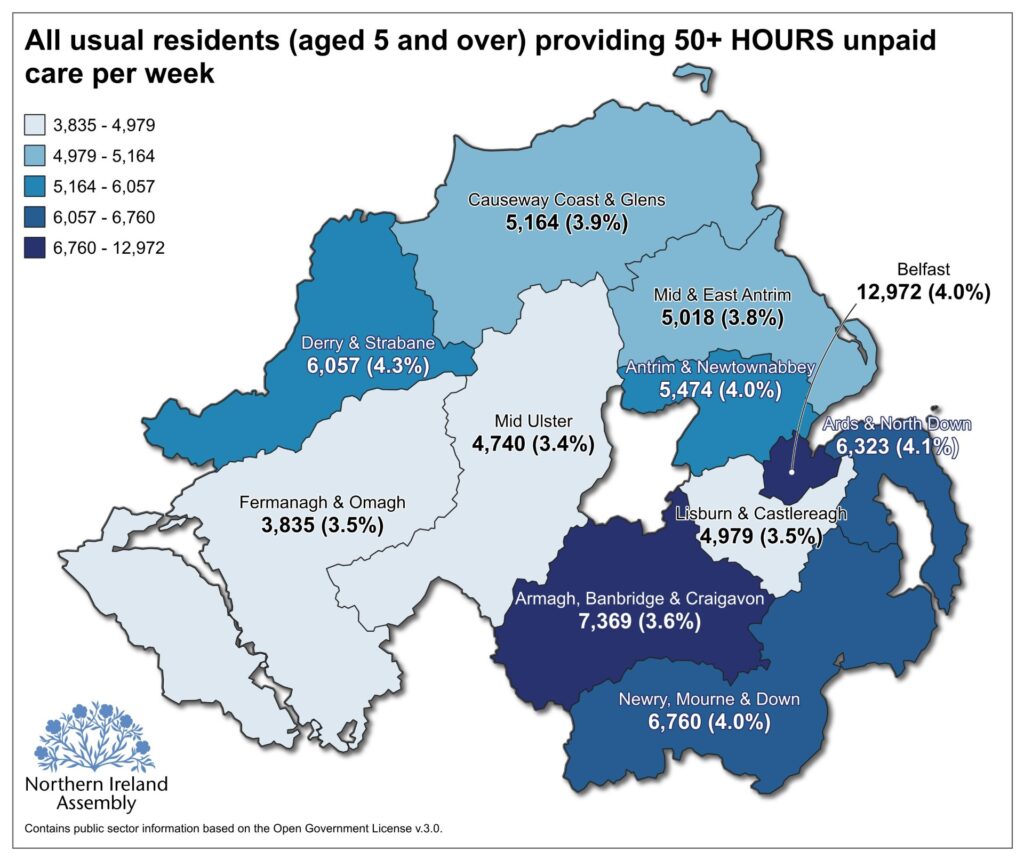
The poverty rate for carers is higher compared to non-carers, according to a 2023 report published by Carer Poverty Commission NI. In 2023 the poverty rate for non-carers in Northern Ireland was 17%. This rises to 28% for carers. The poverty rate for carers across the rest of the UK was 24%. Additionally the Northern Ireland Executive published in 2025 that 16% of carers live in deep poverty, meaning they live more than 50% below the poverty line.
The main drivers of poverty among carers in Northern Ireland are:
- Unemployment: 55% of unpaid carers who are out of work live in poverty. Being unemployed is, according to the Carer Poverty Commission, the strongest indicator of poverty.
- Living in rented accommodation: Northern Ireland is currently experiencing a ‘supply crunch’ within the private rental sector, according to the Carer Poverty Commission NI. This situation has resulted in rental prices increasing by 9% between June 2022 and June 2023. The figure for the rest of the UK was 6%.
- Caring for multiple generations at once: Also known as ‘sandwich caring’, this may involve looking after elderly parents and children at the same time.
- Limited employment opportunities: Evidence indicates that many unpaid carers report challenges in remaining in employment. It can be difficult for them to juggle work and care responsibilities. A lack of flexibility and employer support also limits employment opportunities.
The Carer Poverty Commission reported that alongside an increased chance of poverty, carers providing long hours of care experience poor physical and mental health, have limited education and employment opportunities, often feel lonely and isolated and often have no financial safety net.
Measures to support unpaid carers in Northern Ireland
In their 2025 report ‘Tackling poverty amongst unpaid carers’, CarersNI made several recommendations on how unpaid carers can be supported. These recommendations included:
- Improved social security: The report recommended introducing a carers allowance supplement scheme, similar to that in Scotland. This provides an additional payment to carers receiving a Carer Support Payment. Other recommended support included a monthly Carers Essential Payment to help carers afford the ‘inescapable higher costs of caring they face for the likes of transport, food, energy and clothing.’
- Employment: Recommendations included introducing statutory paid carers leave, separate and in addition to holiday entitlements. Employers should also be encouraged to introduce carer-friendly policies and more supportive workplace cultures for carers. Relevant bodies should support in raising awareness of carers rights in the workplace.
Finally, the report recommended that the Northern Ireland Executive develops a new carer strategy to replace the Caring for Carers strategy, published in 2006. This included recognising unpaid caring as a protected characteristic and introducing respite services for unpaid carers. The 2014 Care Act placed a duty on Local Authorities in England to deliver care and support services, including respite, to carers when necessary. At the time of writing, it is unclear whether the Northern Ireland Executive will take these recommendations forward.
The Department for Communities is currently developing the Northern Ireland Anti-poverty Strategy, and the consultation for the Strategy closed on 19 September 2025. MLAs Claire Sugden and Cara Hunter have asked Assembly Questions of the Minister for Communities about whether the Anti-Poverty Strategy will respond to the needs of unpaid carers. Responses from the Minister indicate that a range of views were gathered during the consultation, including those from carer representatives. These responses are currently being considered by officials from the Department for Communities.
If you are an unpaid carer, or know one, CarersNI offers help and advice to carers in Northern Ireland.
_____________________
[1] Following conversations with the academics responsible for the GEIUK, these were the only indicators that could be used that gave a consistent, like-for-like, comparison across the whole of the UK.