


Last December marked Universal Human Rights Month, with International Human Rights Day celebrated on 10 December. This date marks the day when the Universal Declaration of Human Rights was proclaimed by the United Nations (UN) in 1948. The day is marked by numerous events, including in Northern Ireland by the Northern Ireland Human Rights Festival. This Festival is organised by the Human Rights Consortium, which last year ran from 7-13 December 2025.
For International Human Rights Day 2025, the theme was ‘Human Rights, Our Everyday Essentials’, with the aim to reaffirm the values of human rights and to show how important they are in shaping our daily lives. As we move into 2026, this blog article looks at how human rights shape life in Northern Ireland by looking at the Human Rights frameworks which exist and how these might impact and support those of us living here.
What human rights frameworks exist?
Last year marked a significant milestone in Human Rights legislation. In Europe it was the 75th anniversary of the Council of Europe’s European Convention on Human Rights (‘the Convention’) and the 25th anniversary of the commencement of the Human Rights Act 1998 in the United Kingdom. Both of these significant pieces of our human rights framework have a particular importance in Northern Ireland.
The Convention was drafted in the aftermath of the Second World War, with the United Kingdom playing a critical role in the founding of the Council of Europe and drafters were inspired by the British common law legal tradition, including that of habeas corpus (protection against unlawful detention). The United Kingdom was also the first state to ratify the Convention in 1951. Ratification of a treaty means that it is now officially binding on the state. The Convention was designed to protect individual’s human rights and basic freedoms. It is a requirement for membership of the Council of Europe (currently made up of 46 member countries) to be a signatory to the Convention. It’s worth noting that although all European Union (EU) member states are members of the Council of Europe, these are two completely separate and distinct organisations.
Rights protected by the Convention include, but are not limited to:
- the right to life (Article 2);
- prohibition of torture (Article 3);
- prohibition of slavery and forced labour (Article 4);
- the right to a fair trial (Article 6);
- the right to respect for private and family life (Article 8);
- freedom of thought, conscience and religion (Article 9), and;
- prohibition of discrimination (Article 14).
The Convention is not just a declaration of these rights, it is also a practical legal instrument. State compliance is supervised by the European Court of Human Rights (ECtHR) and an individual from any member state can take their case there, should they believe that their rights have not been upheld in domestic courts.
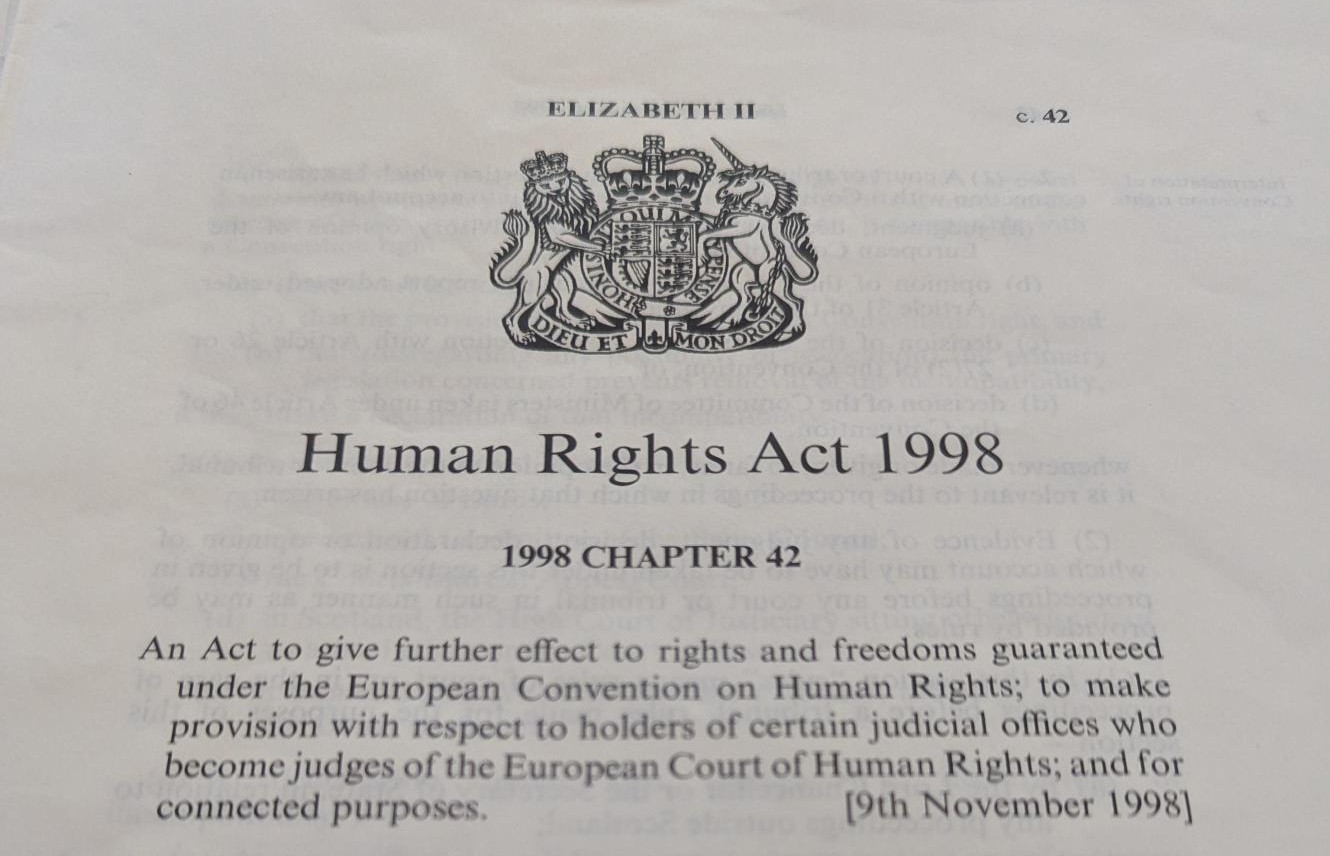
The Human Rights Act 1998 ensured Convention rights are now part of domestic law in the UK. This allows for individuals to rely on their Convention rights in cases taken in domestic courts throughout the UK, before any need to take a case before the ECtHR. The Act requires public bodies to act in a way which is compatible with Convention rights.
In Northern Ireland, the Convention plays a particularly important role. The Belfast/Good Friday Agreement required the incorporation of the Convention into domestic law (achieved through the Human Rights Act). The Northern Ireland Act 1998 sets out that the Assembly cannot legislate in a way that is incompatible with Convention rights. Any Act passed by the Assembly, which is found to breach the Human Rights Act (and therefore the Convention), can be declared void by a Court.
As well as ensuring that legislation it passes must comply with Convention Rights, the Assembly must also ensure legislation passed is also compatible with Article 2(1) of the Windsor Framework. This is a relatively new human rights protection, specific to Northern Ireland. It requires the United Kingdom Government to ensure that there is no diminution of rights, safeguards or equality of opportunity, as set out in that part of the Belfast/Good Friday Agreement, as a result of the United Kingdom leaving the EU. This includes keeping pace with six pieces of EU law, listed in Annex 1 of the Windsor Framework. These are designed to promote equal treatment and tackle discrimination on the following protected grounds: gender; racial or ethnic origin; religion or belief; disability; age, and; sexual orientation.
There are also several international human rights instruments which the United Kingdom Government is signatory to and which it has agreed to follow. Some of these seek to protect more specific rights or groups of people. There are seven core instruments which have been ratified by the United Kingdom. These are:
- The International Covenant on Civil and Political Rights (ICCPR)
- The International Covenant on Economic, Social and Cultural Rights (ICESCR)
- The United Nations Convention on the Rights of the Child (UNCRC)
- United Nations Convention on the Rights of Persons with Disabilities (UNCRPD)
- UN Convention Against Torture and other Cruel, Inhuman or Degrading Treatment or Punishment (UNCAT)
- The Convention on the Elimination of All Forms of Discrimination against Women (CEDAW)
- International Convention on the Elimination of All Forms of Racial Discrimination (CERD)
The United Kingdom, as a whole, has obligations under these international agreements and this includes the devolved governments.
Two instruments that the United Kingdom has not signed or ratified are:
- International Convention on the Protection of the Rights of All Migrant Workers and Members of their Families
- International Convention for the Protection of All Persons from Enforced Disappearance
Several Council of Europe treaties have also been ratified by the UK. These are:
- European Social Charter
- European Convention for the Prevention of Torture and Inhuman or Degrading Treatment
- European Charter for Regional and Minority Languages
- Framework Convention for the Protection of National Minorities
- European Convention on Action against Trafficking in Human Beings
- Convention on Protection of Children against Sexual Exploitation and Sexual Abuse (“Lanzarote Convention”)
- Council of Europe Convention on Preventing and Combatting Violence against Women and Domestic Violence (‘Istanbul Convention’)
The UK has signed but not yet ratified the Revised European Social Charter.
These core human rights instruments are not incorporated into the domestic law in Northern Ireland. Incorporation is a legal process which brings rights treaties into domestic law, meaning domestic courts could enforce them. This is what has happened with the Human Rights Act, in incorporating the Convention.
Other devolved governments have committed to this in relation to some of the human rights treaties. For example, the Welsh Government has partly incorporated the UNCRC into Welsh law via the Rights of Children and Young Persons (Wales) Measure 2011. This requires Welsh Ministers to have ‘due regard’ to the UNCRC when making decisions. In 2021, the Welsh Government also committed to incorporating CEDAW and UNCRPD in Wales, but there has been little progress on this.
In Scotland, the Scottish Government has also incorporated the UNCRC into the Scottish legal system via the UNCRC (Incorporation) (Scotland) Act 2024. This came into force on 16 July 2024.
Whilst none of these international human rights instruments are incorporated into domestic law in Northern Ireland, a published consultation report on a proposed Member’s Bill, sets out that such a Bill would, if enacted as proposed, introduce a statutory duty on public authorities to have due regard to UNCRPD. The recently published Northern Ireland Disability Strategy 2025-2035 notes the importance of fulfilling the obligations under UNCRPD and the Northern Ireland Executive commits to reviewing how it can best be incorporated into legislation here.
What does this human rights framework mean in practice?
The above is a snapshot of some of the most important pieces of the international and domestic human rights framework in the UK. But what do they do in practice and how have they impacted people in the UK and in Northern Ireland? In this section, this blog article will identify a small number of examples where human rights protections have had real world implications.
The ECtHR has made several judgments which have changed the law in the UK (both as a whole and/or specifically in Northern Ireland). For example, in 2020 a judgment by the ECtHR (in J.D. and A. v. the United Kingdom) led to a change in the law to clearly exempt victims of severe domestic violence who were a part of the special Sanctuary Scheme from cuts to housing benefits.
In 1981, the ECtHR ruled (in Dudgeon v. the United Kingdom) that by criminalising homosexuality, Northern Ireland had violated people’s right to a private life. As a result, in 1982, the law was changed to legalise homosexual acts between consenting male adults. The judgment was seen as a test case, which was followed by many others at the ECtHR. It led to the decriminalisation of homosexuality in many European countries.
Changes have been made before cases have reached the ECtHR too. For example, the UK Supreme Court (in Re Siobhan McLaughlin [2018] UKSC 48) found that the law on claiming a widowed parent’s allowance (WPA), which required a widowed parent to either be married to or be the civil partner of the deceased, unjustifiably discriminated against a surviving unmarried partner and their children. Whilst the Court noted that the promotion of marriage and civil partnership was a legitimate aim, the WPA was intended to diminish the financial loss caused to families with children by the death of a parent. The Court took the position that the children should not be disadvantaged because their parents did not marry and held that the law was in breach of article 14 read with article 8 of the ECHR. The Court issued a declaration of incompatibility and ultimately Parliament decided to amend the law through the Bereavement Benefits (Remedial) Order 2023.
The Supreme Court (in Dillon & Ors v Secretary of State for Northern Ireland) is also currently considering a case in relation to UK Government legislation concerning the legacy of the troubles. This case raises issues relating to compatibility with both the Convention and Article 2(1) of the Windsor Framework and judgment is expected in 2026. It has potentially wide-ranging implications, particularly in relation to whether Article 2(1) of the Windsor Framework can disapply primary legislation as was found to be the case by the Northern Ireland Court of Appeal.
The United Kingdom’s ratification of the European Charter for Regional and Minority Languages enhances protections for Irish and Ulster-Scots as well as Cornish, Manx Gaelic, Scots, Scottish-Gaelic and Welsh (although it is worth noting that protections vary between languages). A report by the CEDAW Committee became legally binding when a duty was placed on the UK Government to ensure its recommendations were implemented in Northern Ireland in relation to access to, and education related to, abortion services.
The future of human rights protections?
Human rights law continues to evolve, particularly in Northern Ireland with the protections included in the Windsor Framework. However, there have been growing calls in some quarters for wholesale changes. Both the Conservative and Reform Parties have laid out that they would seek to withdraw the United Kingdom from the Convention. The current Labour Government have committed to remaining party to the Convention but have made clear their willingness to look to reform it, particularly in relation to how it interacts with migration. This is an area Council of Europe members have agreed to negotiate on.
Whilst this blog article doesn’t seek to discuss the impacts of such a move, it is important to remember the particular role of the Convention in Northern Ireland. The Shadow Attorney General, whose advice led to the position taken by the Conservatives, argues that withdrawal from the Convention is fully compatible with the Belfast/Good Friday Agreement.
Many others, however, argue that leaving the ECHR would breach the Belfast/Good Friday Agreement (BGFA). The Northern Ireland Affairs Committee at Westminster published a summary of evidence it heard on the subject in May 2024. Among this, was an argument that it is unlikely the United Kingdom could withdraw from the ECHR without triggering a review procedure built into the BGFA. They stated that withdrawal would affect cross-border collaboration in criminal investigations and have other practical implications for policing. A report commissioned by the Committee for the Administration of Justice also set out that withdrawal would breach the Agreement.
Conclusion
As has been set out, human rights frameworks protect a wide variety of rights, from the right to life to protections for minority and indigenous languages. With the strength of these protections varying from international norms and agreements to the ability to take court action locally and internationally if you believe your rights have been breached. Arguments for and against reform to this framework continue and whilst changes to, or the removal of, rights protections may be legally possible, the potential political, social and real world implications are important considerations in what happens next.