


Homelessness is a significant problem in Northern Ireland, and is one of nine strategic priorities in the current Programme for Government. This article provides a brief profile of the homeless population. Beginning with a definition of what constitutes statutory homelessness, the article proceeds to quantify the scale of the issue, including the so-called ‘hidden homeless’. This is followed by a brief exploration of the reasons why people become homeless, and a breakdown by age and gender. Other issues outlined include the use of temporary accommodation housing supply, affordability, and the impact on people of the lack of affordable housing.
What is homelessness?
In Northern Ireland, the statutory definition of homelessness comes from Article 3 of the Housing (Northern Ireland) Order 1988. The 1988 Order sets out four tests which must be met before an applicant can become eligible for a ‘full duty’ by the Northern Ireland Housing Executive (NIHE) to provide accommodation.
The four tests are whether the presenter [1] is:
- Eligible for assistance
- Homeless or threatened with homelessness
- In priority need; and
- Unintentionally homeless.
A presenter who passes all four tests is known as a Full Duty Applicant (FDA). FDAs receive 70 points on the Common Selection Scheme, and are entitled to temporary accommodation while waiting for a permanent home.
Failing to meet the criteria for one or more of the four tests, means the Housing Executive is not required to provide support. Instead, they retain a duty to offer advice about homelessness, and the prevention of homelessness, to anyone who seeks this information.
Profile of homelessness
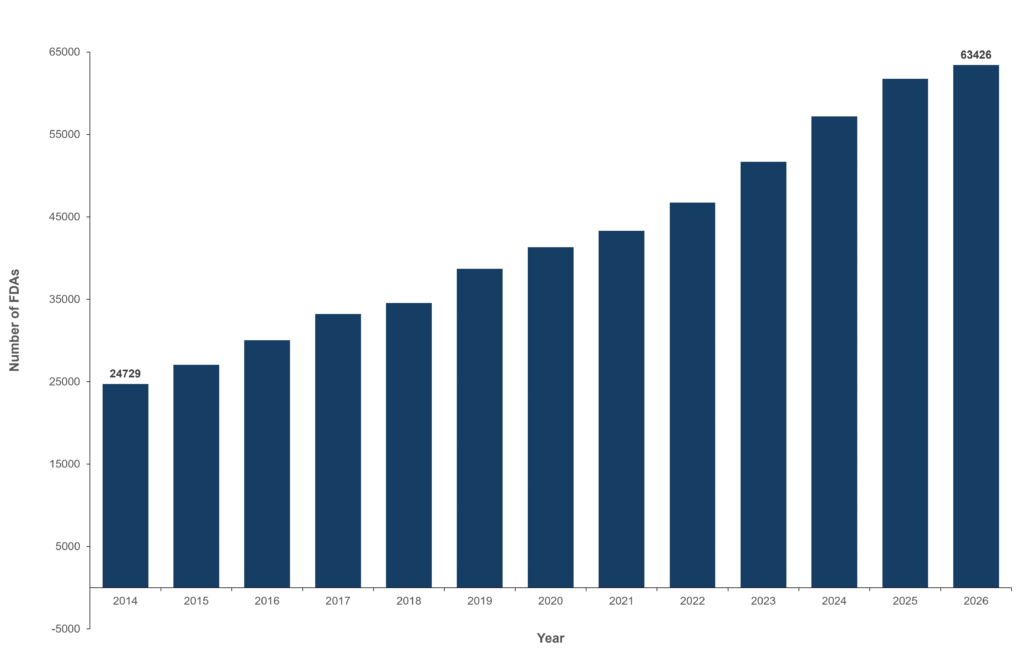
Homelessness in Northern Ireland has increased substantially over the past decade. Table 1 shows the number of persons who are deemed to be either in housing stress [2], or have been categorized as Full Duty Applicants (Chart 1), for the period ending 31 March 2014–2026.
Table 1: Number of Persons in Housing Stress or with FDA status, 2014–2026
| Date/Year | No. of People in Housing Stress | No. of People with FDA status |
| 2014 | 39,064 | 24,729 |
| 2015 | 40,325 | 27,036 |
| 2016 | 42,033 | 30,027 |
| 2017 | 44,132 | 33,210 |
| 2018 | 45,042 | 34,562 |
| 2019 | 49,379 | 38,701 |
| 2020 | 52,126 | 41,319 |
| 2021 | 55,936 | 43,294 |
| 2022 | 58,519 | 46,742 |
| 2023 | 61,913 | 51,678 |
| 2024 | 66,866 | 57,188 |
| 2025 | 70,508 | 61,069 |
| 2026 | 72,352 | 63,426 |
| % change 2014-26 | 85.2% | 156.5% |
Source: Assembly Questions, AQW 14882/22-27; (ii) Corporate Communications, NIHE, May 2026
At 31 March 2026, there were a total of 91,986 individuals on the NIHE Waiting List. Table 1 reveals that the number of persons in housing stress has grown by 85.2 per cent since 2014. But the largest increase is in the number of applicants who have been awarded FDA status, which means they are statutorily homeless. This figure has increased from 24,727 in March 2014 to 63,426 in March 2026, a rise of 157 per cent. The trends in homelessness acceptances are shown graphically in Chart 1.
While the official figure of 63,426 people who are statutorily homeless (March 2026) is a reminder of the scale of the current homelessness crisis, the true figure may be even higher.
Hidden homelessness
The Simon Community (2024) recently pointed out (page 1) that:
Many people experiencing homelessness do not show up in official statistics. Often staying with friends or relatives, ‘sofa surfing’, living in severely overcrowded conditions, squatting, not connected to support services and not visible or ‘hidden’ from the systems designed to support them.
Using a survey methodology, Simon (2024) provided a central estimate of around 23,000 people who are hidden homeless in Northern Ireland, and do not show up in official figures. FactCheckNI (2024) has reviewed the research and declared the estimate to be credible.
Simon Community (2024) also explored the reasons behind the journey into hidden homelessness. The main reasons cited by respondents were loss of private rental accommodation (37%), loss of or reduced income (16%), job loss (13%), loss of owned or mortgaged home (8%), and exit from an institution, such as care, hospital or prison (3%).
Reasons for homelessness
Table 2 lists the reasons cited by applicants for presenting as homeless to the Housing Executive during the financial year, 2024–25. The most common reason, named by almost a quarter (25%) was ‘accommodation not reasonable’. This catch-all category includes a number of factors including financial hardship, physical and mental health issues, violence and overcrowding.
Other reasons include family disputes (23%), loss of rented accommodation (16%) and marital breakdown (9%). One striking finding was that 1,205 people (8%), or nearly four per day, cited domestic abuse as their reason for presenting to the Executive.
Table 2: Reasons cited by Applicants for presenting as Homeless, 2024–25
| Reason | 2024-25 | Per cent (%) |
| Accommodation not reasonable | 3,934 | 24.7 |
| Sharing breakdown/ family dispute | 3,621 | 22.8 |
| Loss of rented accommodation | 2,544 | 16.0 |
| Marital /relationship breakdown | 1,404 | 8.8 |
| No accommodation in Northern Ireland | 1,349 | 8.5 |
| Domestic abuse | 1,205 | 7.6 |
| Neighbourhood harassment | 966 | 6.1 |
| Release from hospital/prison /other institution | 430 | 2.7 |
| Intimidation | 185 | 1.2 |
| Other reasons | 93 | 0.6 |
| Mortgage default | 6 | 0.5 |
| No data on reason for presentation | 62 | 0.4 |
| Fire/flood /other emergency | 36 | 0.2 |
| Total | 15,905 | 100.0 |
Source: NI Housing Bulletin, Oct–Dec 2025, Table 2.4
The term ‘households’ represents a number of categories, ranging from single persons to couple, families, and senior citizens. All of them are affected by the trauma of homelessness.
Household type
Table 3 contains a breakdown of households accepted as homeless (FDAs) by household type in the year ending 31 March 2025. Families are the largest category, representing a third of all full duty applicants (34%), followed by single males (27%) and pensioner households (18%).
Table 3: Homeless Presenters by household type, 2024–2025
| Household Type | Total | Per cent |
| Single males (16-25 yrs) | 607 | 5.6 |
| Single males (26-59 yrs) | 2,347 | 21.6 |
| Single females (16-25 yrs) | 751 | 6.9 |
| Single females (26-59 yrs) | 1,157 | 10.7 |
| Couples | 466 | 4.3 |
| Families | 3,630 | 33.5 |
| Pensioner Households | 1,894 | 17.5 |
| Total | 10,852 | 100.0 |
Source: Table 2.7, Northern Ireland Housing Bulletin, October–December 2025.
Temporary accommodation
A person who meets the four tests, and is deemed to be statutorily homeless (FDA), is entitled to temporary accommodation. Table 4 contains a breakdown of the number of placements [3] in temporary accommodation during the period, April–September 2025 by accommodation type, a total of 5,959 households. It reveals that Non-standard accommodation (Hotels/B&Bs) was the largest category with 2,174 placements (37%). Crash facilities were second with 1,506 (25%) placements, followed by private single lets, with 1,092 placements (18%). Voluntary sector hostels [4] were also widely used, with 711 (12%) placements.
Table 4: Household placements in temporary accommodation by type, April–September 2025
| Accommodation Type | Total | Per cent |
| Non-standard (Hotel\B&B) | 2,174 | 36.5 |
| Crash facilities [5] | 1,506 | 25.3 |
| Private single lets | 1,092 | 18.3 |
| Voluntary sector hostels | 711 | 11.9 |
| Other | 476 | 8.0 |
| Total | 5,959 | 100.0 |
Source: Table 3.2, Northern Ireland Homelessness Bulletin, April 2025–September 2025, available here
The total cost of providing temporary accommodation in Northern Ireland has risen substantially over the past seven years, from £5.8 million in 2018/19 to an estimated £40 million in 2024/25 (source: Assembly Question, AQW 29665/22-27). In response, the Minister for Communities, Gordon Lyons, approved a new initiative from the Housing Executive, which will improve provision, and ‘reduce the cost of providing temporary accommodation by up to £75m over the next seven years.’ He approved a plan which will allow the Housing Executive to purchase up to 600 homes over the next three years (2025–2028) to use as temporary accommodation.
One of the underlying factors behind the growth of homelessness in Northern Ireland, is the lack of affordable housing.
Housing supply and affordability
In common with many other countries across Europe, Northern Ireland is facing what has been termed a ‘housing crisis’, with high demand, a shortage of supply, spiralling rents, and excessive house price inflation. Demand for social housing is at an all-time high: in June 2025, there were a total of 49,129 households on the Common Waiting List, representing 90,575 people, an increase of almost a quarter (24%) on the 72,969 people waiting for social housing in 2014.
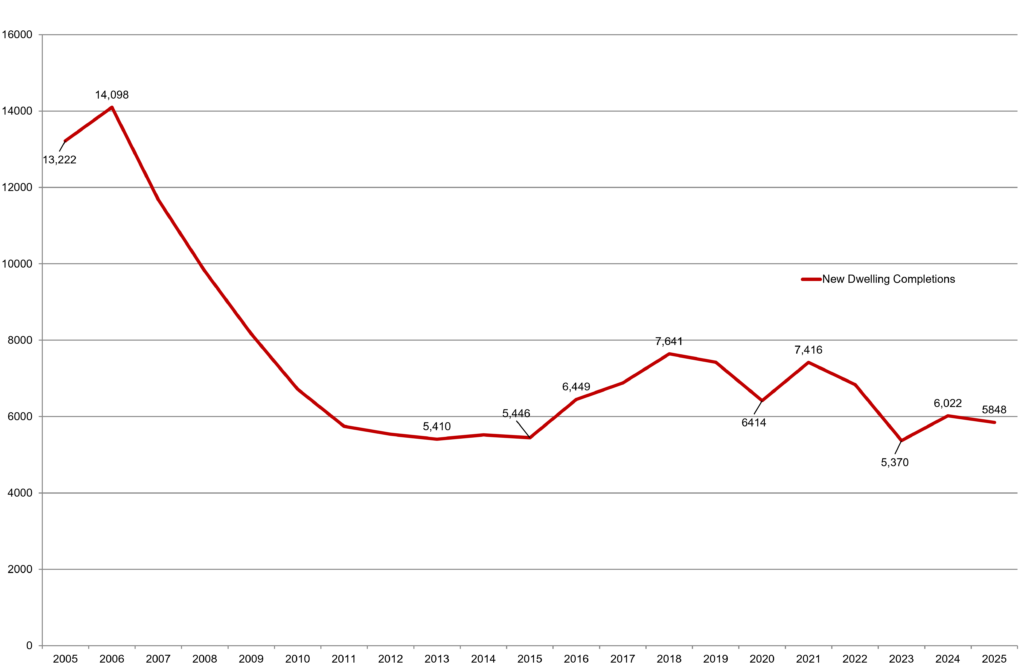
Chart 2 highlights the extent of the housing supply problem. In 2005, a total of 13,222 new housing units were completed (both private and public). The following year the total was even higher, at 14,098. Then came the Global Financial Crisis of 2008, followed by a housing market collapse. In 2023, only 5,371 dwellings were built in Northern Ireland, rising to 6,026 in 2024, before falling again to 5,848 in 2025. Meanwhile, the population continues to increase: between 2005 and 2024, the resident population of Northen Ireland rose by an estimated 200,122 (12%), from 1,727,733 to 1,927,855.
There are a number of data sources on rents in different regions of the UK, including Northern Ireland, which primarily rely on estimates. These include the Office For National Statistics (ONS), Ulster University, which compiles a Northern Ireland Rental Index, and Property Pal, which produces a quarterly NI Housing Market update.
Property Pal, for example, indicates that demand is well above historic norms, with an average of 52 enquiries per advertised rental property in Q.4 2025, nearly 60 per cent above long-term norms. Based on an analysis of newly listed properties on their website, Property Pal estimate that average rents (all properties) in Belfast have increased from £885 in January 2023 to £1,162 in December 2025, a rise of 31 per cent since the start of 2023 [6].
The ONS estimate that private rents in Belfast averaged £1,130 a month in January 2026, a 5.8 per cent rise over the previous 12 months. While rents are generally lower outside Belfast, they have also risen substantially across all parts of Northern Ireland in recent years. The Chartered Institute of Housing recently (November 2025) published new research which highlights the growing unaffordability of private renting across Northern Ireland. House prices are also under pressure: the standardised price of a dwelling (all dwellings) has almost doubled over the past ten years, from £104,989 in Q1 2015 to £195,936 in Q4 2025 (LPS, 2026).
Homelessness is not just about a lack of shelter. It is a deeply personal crisis that affects a person’s physical health and emotional wellbeing.
Impact of homelessness
In Northern Ireland, 70 per cent of homeless individuals report being diagnosed with mental health conditions, including anxiety, depression, and PTSD. The trauma of losing one’s home, with all the security that provides, creates considerable psychological stress. Vulnerable groups, such as children, the elderly, care leavers, people with disabilities, and women fleeing domestic violence, are particularly at risk of emotional distress and physical ill-health.
High rents can mean that vital public sector workers, such as nurses, teachers and care workers, are being increasingly priced out of the communities they serve, leading to potential labour shortages. And those who do secure jobs are often forced to endure long commutes, as they cannot afford to move closer.
Strategies to end homelessness
The Housing Executive and its various partners, including local councils, Health Trusts, the PSNI, charities, and voluntary organisations, have launched various initiatives in recent years to tackle homelessness. In accordance with the Housing (Amendment) Act (Northern Ireland) 2010, the Housing Executive has a duty to publish a new homelessness strategy at least every five years. The current strategy, Ending Homelessness Together: Homelessness Strategy 2022-27 states that, ‘Wherever possible homelessness should be prevented; but if homelessness cannot be prevented it should be rare, brief and nonrecurring’ (page 5).
One action derived from the current Homelessness Strategy 2022–2027 is the Complex Lives model. ‘Complex Lives’ is led by a multi-disciplinary team (MDT), with membership including the Housing Executive, Belfast City Council, Probation Board, PSNI, Belfast Health and Social Care Trust, Extern, Welcome Organisation, Simon Community and DePaul. The model is mainly targeted at those with addiction issues, and adopts a Housing First [7] approach, with wrap-around support provided by various agencies.
Other related strategic documents to tackle homelessness include a Youth Homelessness Action Plan (November 2024) and a Chronic Homelessness Action Plan (January 2020).
Summary
In brief, a number of factors – including a growing population, high demand for housing, inadequate supply, spiralling rents and house price inflation – help to explain why the number of statutorily homeless people in Northern Ireland continues to rise.
Homelessness encompasses a wide variety of living arrangements, including hostel accommodation, hotels, B&Bs, single lets, and so-called ‘sofa surfing’ (staying with friends or relatives). But, the most vulnerable and marginalised group of all – rough sleepers – live on the streets. A future blog article will review this group in more detail.
_______________
[1] Presenters refer to those persons who have made an initial application to the Housing Executive for rehousing, but whose cases have not yet been assessed. Presenters may be ineligible for assistance from the Housing Executive if they are (i) deemed guilty of unacceptable behaviour; or (ii) because of their nationality. This is a complex category, but includes those who have no right to reside in Northern Ireland and/or have no recourse to public funds.
[2] Housing Stress refers to a person on the Social Housing Waiting List who has been awarded 30 points or more under the Housing Selection Scheme.
[3] Table 4 presents the overall number of placements in a given time period and does not represent distinct households. One household may have several placements in a short timeframe.
[4] Voluntary sector hostels include organisations such as the Simon Community, Salvation Army, the Legion of Mary and other faith-based societies.
[5] Crash beds are emergency, overnight sleeping spaces in hostels or shelters, offered by the Housing Executive (NIHE) or charities for rough sleepers, or those in immediate housing crisis, when no other options exist. Crash beds are typically for just one night, requiring people to leave in the morning.
[6] According to Property Pal (2025), ‘… the price and rental statistics are based on arithmetic averages of newly listed properties based on advertised asking price/rents in each calendar month. The price and rental indices produced are weighted to reflect the market share of each property type. The data has been cleansed to remove outliers and anomalies.’
[7] The Housing First model originated in New York in the 1990s. It was developed as a new approach to support people who experienced chronic homelessness, (particularly those with complex issues or mental health conditions), by providing immediate access to permanent housing without preconditions – see Chartered Institute of Housing (2024) Housing First in the UK and Ireland.