

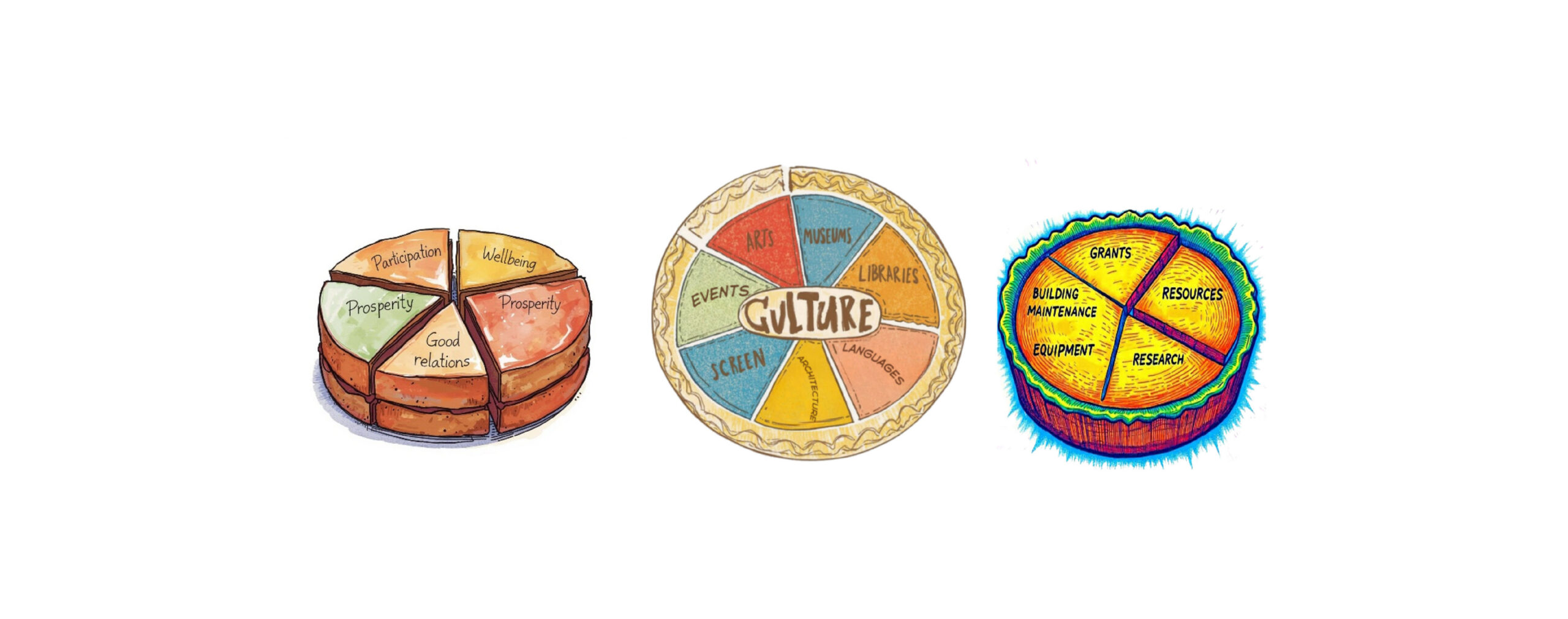
With a new arts policy expected in Spring 2026, under the Department for Communities’ Heritage, Culture and Creativity Framework, this blog article – the first of two such posts – outlines how Members may wish to examine definitions of cultural services, particularly the arts. It also highlights the complexity of comparing levels of publicly funded arts investment in Northern Ireland with those in England, Scotland and Wales. Clarity around what is included under ‘cultural services’ is helpful for understanding both the scope of the Framework and the basis on which financial comparisons are made. The second article in this blog series examines public investment in arts and cultural services.
To accompany this series of blog articles, RaISe has created a dashboard, below, which provides a summary of analyses for different publicly available data sources about investment and engagement in arts and cultural services (scroll down to view each of the visualisations).
Although ‘culture’ is widely used in policy documents, its scope varies considerably depending on the context. In Northern Ireland, the term has been used to refer to the arts, heritage, language, museums, libraries, creativity, community activity and, in some cases, tourism. Because each area has its own policy logic and funding arrangements, broad definitions can make it harder to identify how resources flow and which sectors benefit most.
Changes in departmental structures have contributed to this complexity. Under the former Department of Culture, Arts and Leisure (pre‑2016), responsibilities included Cultural Diversity, Arts, Creativity and Architecture. Under the Department for Communities (DfC), the most recent framework brings together Heritage, Culture and Creativity. Each configuration signals slightly different priorities for cultural services, with implications for what is measured, funded and scrutinised.
Using wide definitions can allow acknowledgement of the full breadth of cultural activity. However, as some commentators have observed, this can make it more challenging to see how support reaches practitioners, organisations and communities. For Members engaged in scrutiny, understanding what is being counted – and what is not – helps ensure that policy intentions and resource allocations can be thoroughly examined.
From definitions to scrutiny
Understanding how cultural policy is shaped involves more than analysing spending lines. It also requires examining the mechanisms by which decisions are reviewed and assessed. One such mechanism is the role played by the Assembly’s Communities Committee. As set out in the Northern Ireland Act and Assembly Standing Orders, the Committee scrutinises DfC’s decisions and how these align with policy ambitions, including those relating to arts and cultural services.
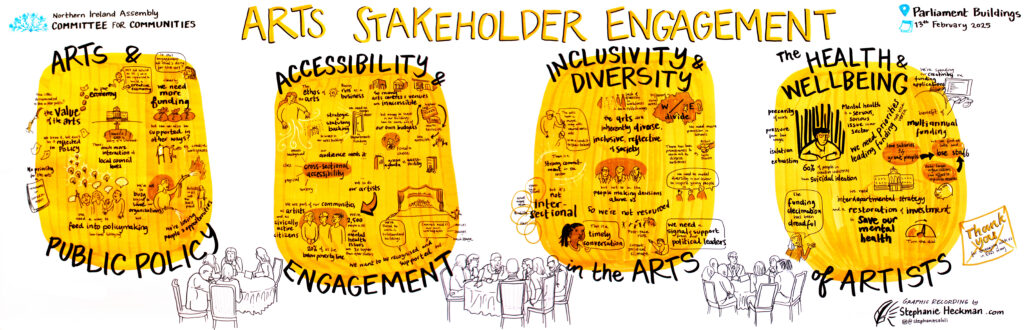
Committee scrutiny helps surface gaps between policy aims and the practical experiences of cultural organisations. The Committee regularly receives input from the sector, such as through its stakeholder engagement sessions. These discussions inform scrutiny by highlighting issues such as arts career pathways, facilities, and the relationship between arts funding and wider wellbeing or participation goals. While the Committee can raise these issues with the Communities Minister, it does not allocate public funding.
How definitions affect funding comparisons
This scrutiny context also helps frame the wider picture, providing a useful basis for examining how cultural responsibilities and expenditure differ across the UK’s jurisdictions.
When comparing cultural expenditure across jurisdictions, definitions again play a central role. For example, international datasets such as those compiled by the OECD categorise ‘cultural services’ broadly, often including libraries, museums, broadcasting and local cultural infrastructure. These classifications differ from national or regional funding lines targeted specifically at the arts.
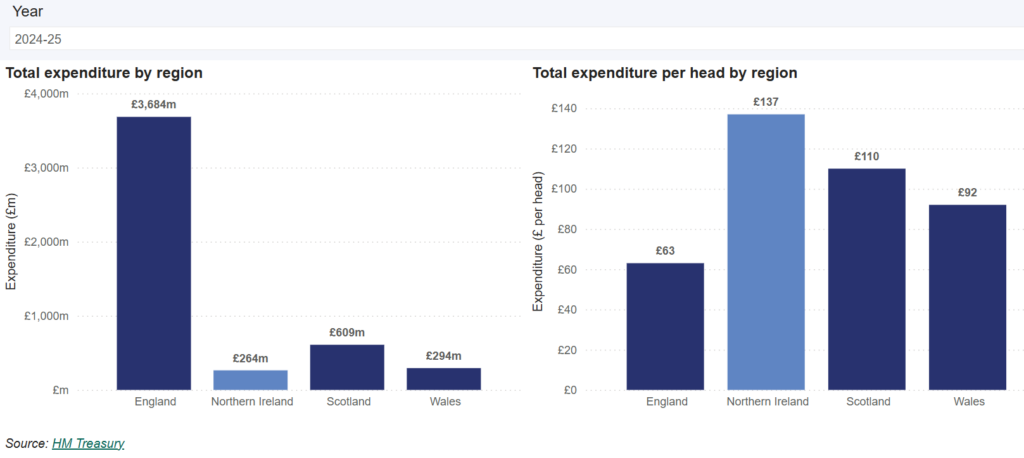
Explored more in part two of this blog series, this perhaps partly explains why Northern Ireland appears to spend comparatively more on cultural services while direct grants for the art council here are lower per capita than elsewhere in the UK.
As discussed further in part two of this blog series, the apparent contradiction perhaps reflects the difference between maintaining cultural infrastructure and directly funding artistic activity. Members interpreting budget data may wish to consider how expenditure is classified and which activities it supports.
How publicly funded cultural services are organised across the UK
To illustrate the impact of definitions on funding, the table below sets out the range of publicly funded cultural bodies across the UK, adapted from University of Warwick research titled The State of the Arts, published in 2024. This highlights how responsibilities differ from one jurisdiction to another. These structural differences help explain why direct like‑for‑like comparisons of arts investment are complex.
Table 1: Publicly funded bodies in UK arts and culture (adapted)
| UK | England | Wales | Scotland | Northern Ireland | |
| National development agencies | |||||
| Moving Image | British Film Institute | Arts Council of Wales | Creative Scotland (including Screen Scotland) | NI Screen | |
| Arts | Welsh Government Culture Division | Arts Council of Northern Ireland | |||
| Museums and galleries | Arts Council England | Museums Galleries Scotland | Northern Ireland Museums Council | ||
| Public Libraries | Scottish Library and Information Council | Libraries NI | |||
| Cultural and built heritage | National Heritage Memorial Fund | Historic England | RCAHM Wales and Welsh Government | Historic Environment Scotland | DfC Historic Environment Division |
| National cultural organisations | |||||
| National museums and galleries | 3 MoD sponsored service museums | 15 DCMS sponsored museums and galleries | National Museums of Wales | National Museums Scotland and National Galleries Scotland | National Museums NI |
| National library | British Library | National Library of Wales | National Library of Scotland | ||
| National archives |
National Archives |
National Records of Scotland | Public Records Office of Northern Ireland | ||
| National performing companies | National Performing Companies | ||||
| National broadcaster | BBC and S4C in Wales | ||||
Across the UK, cultural responsibilities are distributed among a range of national development agencies and national cultural organisations. For example, moving image responsibilities fall to the British Film Institute at UK level, while in Scotland they sit with Creative Scotland, and in Northern Ireland with NI Screen, which is funded by the Department for the Economy in Northern Ireland, rather than the Department for Communities (DfC), which funds the Arts Council of Northern Ireland.
Arts responsibilities are devolved, where Arts Council England operates at arm’s length from DCMS, in Wales responsibility for Arts Council Wales sits within the Welsh Government Culture Division, and in Northern Ireland DfC’s Culture Division has responsibility for the Arts Council of Northern Ireland and the Minister for Communities set out his expectations for strategic alignment in February 2025.
Museums, galleries, archives and libraries also diverge, with national bodies in Scotland and Wales having different mandates than their Northern Ireland equivalents. And heritage functions range from Historic England to DfC’s Historic Environment Division.
These variations mean that each jurisdiction presents a different landscape of bodies, responsibilities and funding streams. As a result, comparing arts and cultural services investment between jurisdictions requires careful attention to what is included within ‘culture’ and how responsibilities are divided among agencies. Also, local councils across the UK vary in their level of contribution to cultural services.
Members may therefore find it helpful to consider not only the total levels of expenditure but also the underlying responsibilities of each funding body and how these align with devolved and national policy objectives. This approach avoids drawing categorical conclusions.
Scrutinising participation
On the flipside, understanding these jurisdictional distinctions provides helpful context for considering how cultural investment relates to participation in arts and cultural activities across Northern Ireland.
Participation in arts and culture is increasingly used as a policy metric for wellbeing. The Northern Ireland Executive includes arts and culture engagement as an indicator within the Programme for Government (PfG), reflecting the potential contribution of cultural activity to social cohesion, mental health, and community engagement.
When examining participation levels, Members may wish to consider them in the context of public investment in the arts. Comparisons across UK jurisdictions suggest that Northern Ireland receives lower per-head grant funding for its arts council than Scotland, Wales or England. Possible consideration could include whether these differences in investment correspond with differences in participation rates, and whether investment levels may influence accessibility, availability or diversity of cultural engagement.
Academic analysis indicates that while cultural participation is frequently referenced in policy, there may be a gap between stated ambitions and measurable outcomes. In a 2020 blog post, Professor David Stevenson noted that cultural participation policies can reflect a ‘poverty of ambition’ focusing on headline participation numbers rather than quality, diversity or inclusivity of engagement. Members may wish to examine whether participation metrics sufficiently capture both breadth and depth of engagement and how this aligns with public investment frameworks.
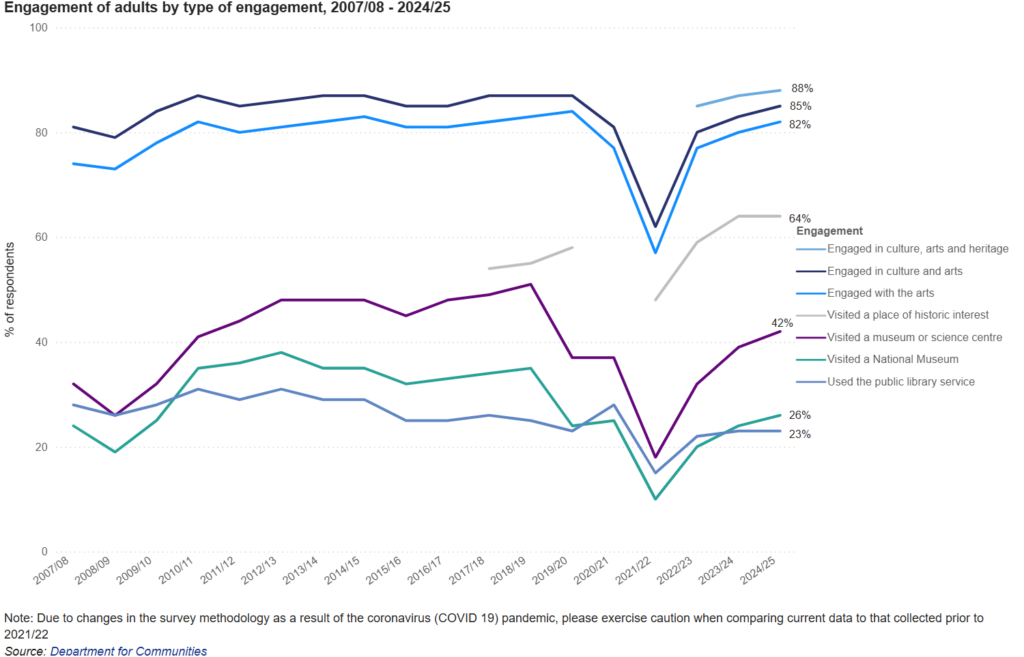
This line graph shows the trends in cultural activities from 2007 to 2025. Members may wish to examine whether policy interventions correspond with changes in participation and consider whether further monitoring or evaluation may be required.
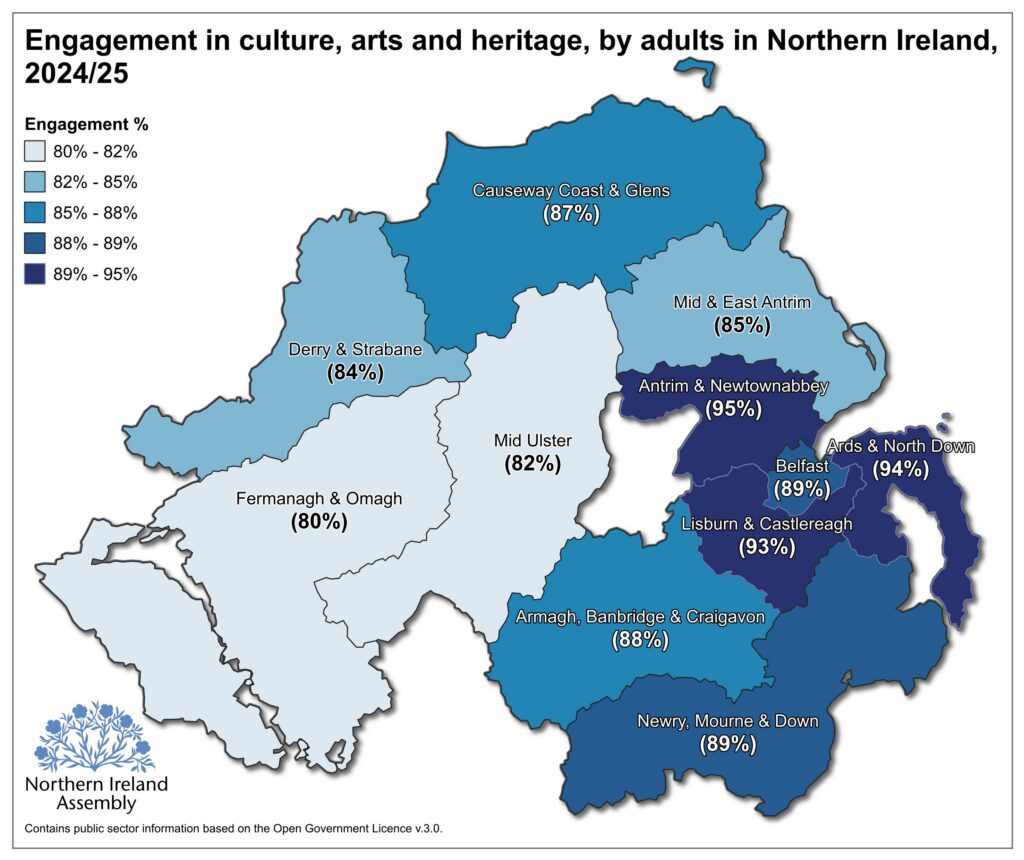
This map shows the percentage of adults engaged in culture, arts and heritage activities by local council area.
Possible considerations for Members may include whether disparities in participation reflect differences in funding allocation, availability of facilities, or targeted outreach programmes.
Members may also wish to assess how participation metrics align with the Heritage, Culture and Creativity Framework’s People mission and the intended objectives for wellbeing, inclusivity and access. Possible consideration could include examining whether participation data is sufficiently granular to inform resource allocation or identify gaps in provision.
Implications for Northern Ireland’s Cultural Policy Framework
DfC’s Heritage, Culture and Creativity Framework is structured around four missions: People, Planet, Prosperity and Peace. Each pillar raises different questions about how cultural services, including the arts, might be defined and supported. For example:
- Under People: Members may wish to explore whether the Framework focuses primarily on cultural participation or also includes artists’ livelihoods.
- Under Prosperity: it may be useful to consider how creative industries are positioned relative to the social and civic value of culture.
- Under Peace: Members may wish to examine how heritage is framed, either as a tool for reconciliation or as a way of documenting difference.
Clarifying these distinctions before the Framework is implemented may help stakeholders understand its scope and assist Members in scrutinising how well resources align with stated ambitions.
Further considerations
Clarifying what counts as culture may support scrutiny of public investment in Northern Ireland’s arts and cultural landscape. As the new policy framework takes shape, clear and consistent definitions may support more informed scrutiny and help illuminate the relationship between cultural ambitions, organisational responsibilities, and the resources available to achieve them. Potential points for consideration may include:
- How are cultural services defined within the Framework, and what is included under ‘culture’?
- How do these definitions affect where resources are directed?
- How do Northern Ireland’s structures compare with those in neighbouring jurisdictions, and what does this mean for interpreting expenditure?
- What information would help ensure alignment between policy goals and funding allocations?
As the new Heritage, Culture and Creativity Framework develops, a shared understanding of what is included under ‘culture’ can help ensure that policy intent, funding structures and participation outcomes are interpreted accurately. For Members, this clarity supports more effective scrutiny of how cultural ambitions are translated into practice, and whether available resources align with the needs of artists, organisations and communities across Northern Ireland.