



Imagine you are responsible for allocating an additional £1 million to improve health and wellbeing in Northern Ireland. Should it fund smoking cessation services, falls prevention programmes for older people, parenting support for families, or community initiatives tackling loneliness and poor mental wellbeing?
Each option could improve health. Each has evidence behind it. Yet all compete for the same limited resources.
This is a challenge faced by policymakers, commissioners and healthcare leaders alike, with health economics providing an important framework for informing these decisions. Across the UK, growing demand for health and public services has fuelled concerns about a public sector ‘‘doom loop’, where increasing resources are consumed responding to ill health and crisis, leaving less available for prevention and early intervention. The result is a system that can become trapped in a cycle of responding to need rather than reducing it. Northern Ireland’s relatively low healthy life expectancy illustrates the challenge: although people are living into their late seventies and early eighties, they can expect to spend almost two decades in poor health. Every year, more resources are absorbed managing the consequences of ill health, leaving less capacity to address its causes.
Prevention is therefore no longer seen simply as desirable; it is increasingly viewed as essential to the long-term sustainability of public services.
Yet turning ambitions for a ‘prevention revolution’ into reality is far from straightforward. Prevention is not a single intervention but a broad spectrum of activities, ranging from childhood vaccination and breastfeeding support to prescribing (a way for doctors and health workers to connect people to non-medical, community-based activities and support services), early years programmes and support for people living with long-term conditions. Many of the factors shaping health sit beyond the health service itself, requiring coordinated action across government, communities, employers and the voluntary sector.
The policy challenge is therefore not whether prevention matters. The evidence is clear that many preventative interventions improve health outcomes. Rather, the question is how limited resources should be prioritised among competing approaches, particularly where benefits may take years to emerge and where short-term pressures often pull in the opposite direction. At its core, this is a challenge faced by policymakers, commissioners and healthcare leaders alike, with health economics providing an important framework for informing these decisions.
In many ways, the question is not whether Northern Ireland can afford to invest in prevention, but how much it may ultimately pay if it does not.
Prevention and prioritisation
Prevention is not a new concept in Northern Ireland. Successive strategies and reforms have emphasised the importance of improving population health, reducing health inequalities and intervening earlier to avoid more costly and intensive services later. Investing for Health and subsequently Making Life Better promoted a cross-government approach to public health, while Transforming Your Care, the Bengoa Review (Systems, Not Structures), Delivering Together, the Health and Social Care Reset Plan and the Neighbourhood Model of Health and Wellbeing have reinforced ambitions to shift care upstream, strengthen community-based support and focus on prevention and early intervention.
Prevention and early intervention are often discussed together, but they are not identical. Prevention seeks to stop problems occurring in the first place, while early intervention focuses on identifying and responding to emerging problems before they become more serious. Vaccination programmes, smoking prevention initiatives and support for healthy lifestyles are preventative measures. Screening programmes and many family support services are examples of early intervention.
Public health specialists further categorise prevention into three broad categories:
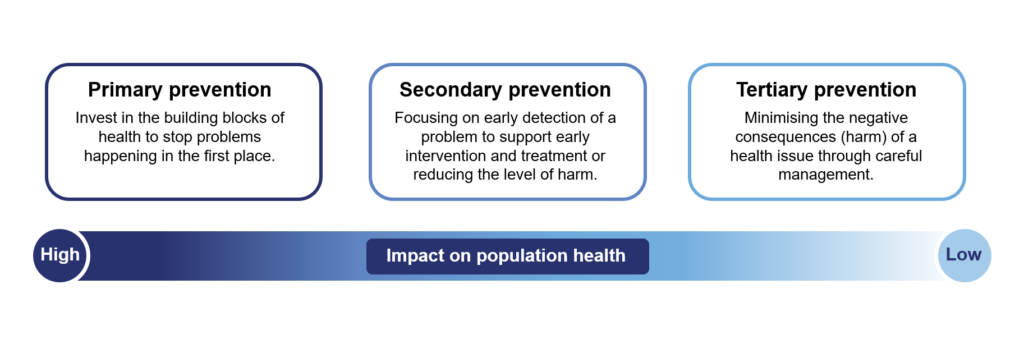
If prevention is part of the solution, difficult choices quickly follow. Every pound invested in one intervention is a pound unavailable for something else. Policymakers therefore face a series of practical questions:
- Does it improve outcomes?
- How strong is the evidence?
- How much does it cost?
- Can it be delivered at scale?
- When are benefits likely to emerge?
- Does it reduce future demand?
- How will success be measured?
The challenge is not that prevention lacks evidence. It is that different preventative interventions produce different benefits, over different timescales and with different levels of certainty. Less than a decade ago, Public Health England produced a Menu of Preventative Interventions focused on interventions that could demonstrate return on investment, cost savings and measurable impacts within relatively short timeframes. Today, prevention debates increasingly encompass health inequalities, population health, community resilience and the wider determinants of health, making choices between competing priorities far less straightforward.
Prevention is not simply about saving money
One of the most common claims made about prevention is that it saves money. Sometimes it does. Vaccination programmes, smoking cessation services and some falls prevention initiatives can reduce future healthcare costs.
However, prevention is often better understood as an investment in reducing future risk. Just as organisations invest in flood defences, cybersecurity or road maintenance to prevent larger problems later, health systems invest in prevention to reduce the burden of avoidable illness.
The value of prevention may therefore lie less in generating immediate savings and more in slowing the growth in demand, improving quality of life and reducing future pressure on services.
This distinction matters.
If prevention is judged solely on whether it quickly reduces spending, disappointment is almost inevitable. Helping a smoker quit today may transform future health outcomes without making a noticeable difference to next year’s waiting list.
That does not mean prevention has failed. It means expectations need to match reality.
The argument for prevention is not simply about saving money. It is about avoiding a situation where rising demand continually absorbs resources, leaving less room for the very investments that could improve health in the first place. Put another way, the costs of prevention are often visible today, while the costs of failing to prevent may not become apparent until much later.
Measuring success
One reason prevention struggles to secure sustained investment is that its benefits often materialise over longer time horizons than its costs, making it vulnerable when resources are diverted to address more immediate pressures.
A hospital waiting list can be measured this month. A successful operation can be counted. A heart attack that never occurs because somebody quit smoking twenty years earlier may never appear in any performance dashboard. As a result, immediate pressures often attract greater political and public attention than successful prevention.
Success in prevention is often invisible. It may be the teenager who never starts smoking, the older person who never experiences a fall, or the family that never reaches crisis point. Because these outcomes never happen, they are often overlooked despite representing some of the most important benefits prevention and early intervention can deliver.
The challenge becomes even more complex when success is difficult to measure. Some preventative interventions may take years to produce their intended results. In the meantime, policymakers must rely on early indicators that suggest future benefit. A reduction in HbA1c levels among people at risk of diabetes may appear long before reductions in complications, hospital admissions or healthcare costs become visible.
Likewise, evaluations of social prescribing frequently report improvements in wellbeing, confidence and social connectedness. However, evidence regarding impacts on healthcare utilisation, costs and demand for services is less consistent.
There is also a risk of valuing only what can be easily counted. Some preventative interventions aim to improve confidence, resilience, independence and community belonging. These outcomes may be difficult to express in economic terms, but they remain important.
Questions of measurement are closely linked to questions of fairness. Northern Ireland continues to experience significant inequalities in health outcomes. People living in more deprived communities often experience poorer health, higher levels of chronic illness and shorter healthy life expectancy than those living in more affluent areas.
Should investment focus on generating the greatest overall health improvement, or should it prioritise reducing the gap between those with the best and worst outcomes? In practice these objectives often overlap, but not always.
Prevention therefore involves value judgements as well as economic ones. Decisions about where to invest inevitably reflect choices about fairness, priorities and the type of society we want to create.
The prevention imperative
The case for prevention has become increasingly prominent in health policy debates. Lord Darzi’s 2024 review of the NHS argued that sustainable improvement will require a shift from treating sickness to preventing it, highlighting the links between deteriorating population health, wider social determinants and growing demand for healthcare.
Importantly, Lord Darzi did not present prevention as a single programme or intervention. Rather, it formed one of three major shifts required for the future of health services: from hospital to community, from analogue to digital, and from treatment to prevention.
This raises an important question. If prevention is to become a guiding principle rather than a policy aspiration, what can be learned from approaches that have delivered measurable improvements in population health elsewhere?
What can Northern Ireland learn from elsewhere?
Finland’s North Karelia Project is often regarded as the blueprint for modern prevention. Beginning as a five-year pilot in 1972, it demonstrated how coordinated action across healthcare, schools, communities, industry and government could produce substantial improvements in population health. While the exact circumstances of 1970s Finland are unlikely to be repeated, the project established an enduring principle: lasting improvements in health are rarely achieved through isolated interventions alone. As the King’s Fund has recently argued, a genuine ‘prevention revolution’ depends on coordinated cross-government action on the social, economic and commercial determinants of health, rather than piecemeal measures introduced in isolation.
More recent examples demonstrate how this principle has been applied in different settings. The UK’s Soft Drinks Industry Levy used fiscal policy to encourage manufacturers to reduce sugar in their products, contributing to widespread reformulation and reductions in childhood hospital admissions for tooth extractions due to dental caries. Iceland’s Prevention Model brought together parents, schools, local authorities and community organisations to reduce young people’s alcohol, tobacco and drug use through sustained community action and long-term partnership working.
As Northern Ireland invests in new obesity services (announced 29 June 2026), including a £5 million Regional Obesity Management Service and wider funding for community-based support, international experience suggests that the greatest population health gains are achieved when treatment is combined with sustained action on prevention and the wider determinants of health.
Who delivers prevention?
Many preventative interventions are not delivered in healthcare settings. They take place in homes, schools, community centres, sports clubs and voluntary organisations. This reflects a growing recognition that health is shaped as much by the circumstances in which people live as by the healthcare services they receive.
This is where Northern Ireland’s Neighbourhood Model of Health and Wellbeing becomes particularly relevant, emphasising partnership between statutory services, communities and the voluntary sector.
Examples from Northern Ireland already demonstrate this principle. Breastfeeding support programmes show how relatively modest interventions can contribute to longer-term health outcomes. Men’s Sheds provide another example, with benefits including reduced loneliness, improved wellbeing and stronger social connections.
Prevention often happens through relationships, trust and community participation rather than formal healthcare encounters alone.
Yet delivering this type of prevention requires community capacity as well as clinical services. In 2025, the Department of Health’s Core Grant Scheme was reduced from £3.6 million to £1.8 million, with only a small proportion of applicants receiving support.
This highlights a recurring challenge in public policy: immediate service pressures can make it difficult to prioritise longer-term prevention. As policy places increasing emphasis on neighbourhood working and earlier intervention, sustaining the community and voluntary sector infrastructure that supports preventative activity remains an important consideration. Funding uncertainty may also affect organisational capacity, workforce stability and established community relationships.
The challenge ahead
Northern Ireland’s prevention challenge is no longer simply identifying interventions that work. The evidence base for many preventative approaches is substantial, yet deciding which interventions should be expanded, piloted or prioritised remains considerably more difficult.
Northern Ireland’s ambition reflects a desire to move attention and resources away from responding to crisis and towards preventing need from arising or escalating. As the Neighbourhood Model develops, the focus increasingly shifts from the case for prevention to the practicalities of delivery, raising questions about priorities, evidence, funding and implementation.
Growing demand continues to place pressure on finite resources. Investing in prevention does not remove the need to respond to immediate pressures, but neither can rising demand be considered in isolation from the factors driving future need.
This blog article began with a question about how an additional £1 million might best be spent. By this point, the answer is unlikely to seem straightforward. Smoking cessation, falls prevention, parenting support and community wellbeing initiatives may all represent worthwhile investments, but they offer different returns, over different timescales and with varying levels of certainty.
Ultimately, the challenge is not simply choosing between interventions. It is deciding how much resource should be devoted to reducing future need while immediate pressures continue to grow.
Prevention will not eliminate demand for public services, nor will it provide instant savings. What it may offer is the opportunity to slow the growth in avoidable ill health, reduce inequalities and improve quality of life.
At its heart, the prevention debate is about whether Northern Ireland can break the cycle in which rising demand crowds out investment in reducing future need. The Neighbourhood Model aims to address this through a gradual shift towards community-based care. Mike Farrar, Permanent Secretary at the Department of Health, outlined an aspirational goal of transferring 2% of resources per year over three years from hospital services to Integrated Neighbourhood Teams (INTs). The ambition is clear; the challenge now is translating this aspiration into resource shifts that enable the Neighbourhood Model to deliver its intended outcomes.